
Best Horse Racing Betting Sites – Bet on Horse Racing in 2026
Loading...
The numbers settled the debate years ago. Over eighty per cent of bets placed during the 2024 Cheltenham Festival were made on mobile devices, according to data compiled by Receptional from Flutter Entertainment’s trading figures. That figure was not an anomaly driven by one event — it reflects the structural reality of how people bet on horse racing in Britain in 2026. The app is the product. The website is the fallback. And the betting shop, while far from extinct, serves a different audience for different reasons.
If the app is where you will place the vast majority of your bets, then the quality of that app — its speed, stability, design and feature depth — directly affects your betting experience and, by extension, your results. A slow app means missed prices. A confusing interface means misplaced bets. A stream that buffers during the final furlong means frustration at precisely the moment you need clarity. Mobile-first betting is no longer a trend to acknowledge. It is the baseline standard against which every operator should be judged.
This review evaluates the leading horse racing betting apps available in the UK, focusing on the features that matter to racing bettors: racecards, live streaming, in-play functionality, cash out and the overall user experience on both iOS and Android.
What Makes a Good Horse Racing Betting App?
Not every betting app is built with horse racing in mind. Many operators are football-first in their design philosophy, with racing bolted on as a secondary vertical. The apps that serve racing bettors best are those that treat horse racing as a core product, with dedicated navigation, integrated racecards and a bet placement flow optimised for the rhythm of a racing day.
Speed
In horse racing, odds move fast — particularly in the final minutes before a race. An app that takes three seconds to load a racecard or two seconds to confirm a bet is an app that costs you money. The best racing apps refresh odds in near-real-time, confirm bets within a second and navigate between races with minimal loading. Test this for yourself before a busy Saturday card: place a few low-stake bets during live racing and note how the app performs under time pressure.
Racecard Integration
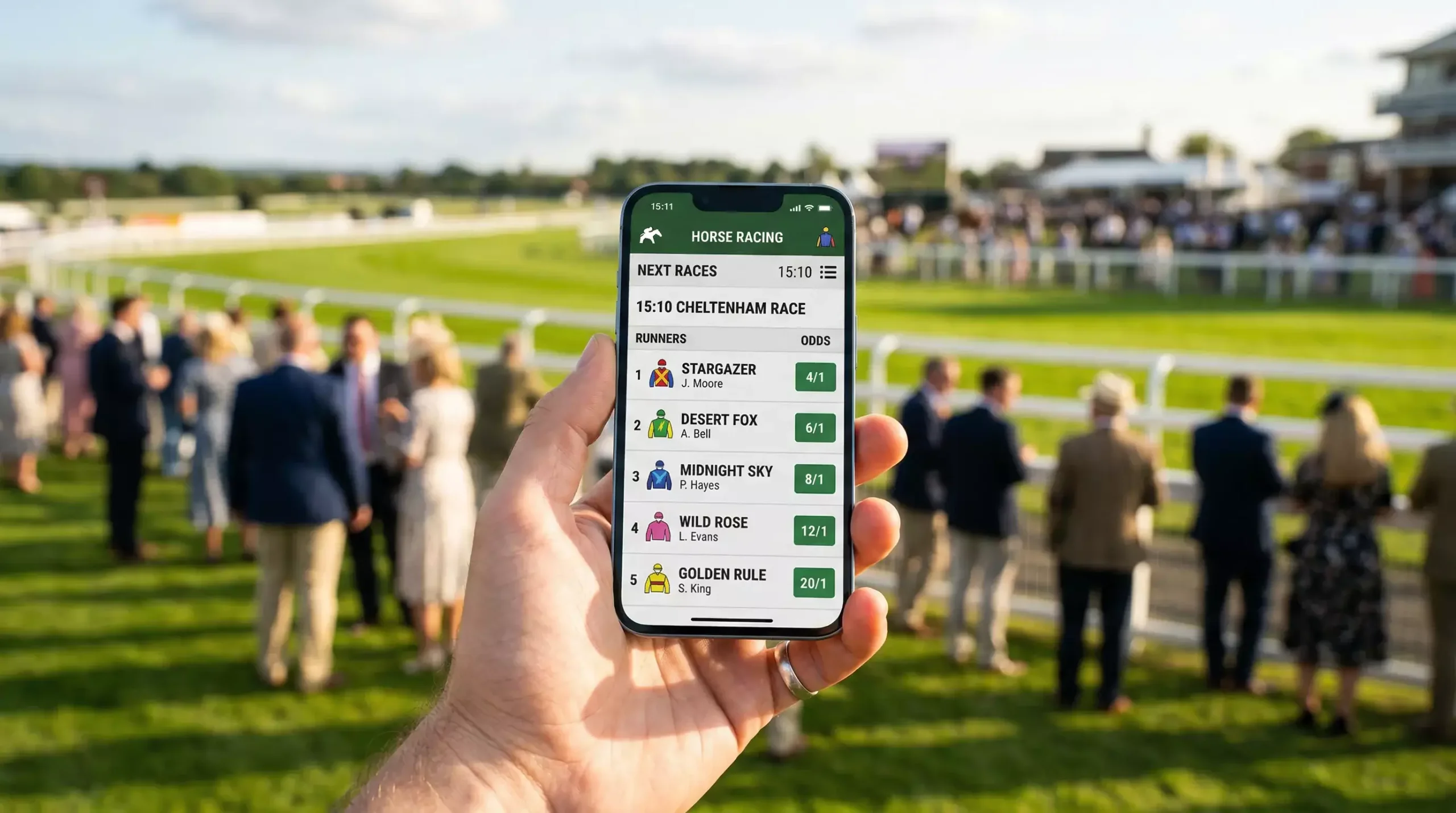
A horse racing app should present the racecard — runners, form figures, jockey, trainer, weight, draw and going — within the betting interface, not as a separate section you have to navigate to and back from. The best implementations allow you to read the form, check the price and place a bet without leaving the race view. This sounds basic, and it is, but the quality of execution varies widely. Some apps present rich, detailed racecards with form comments, trainer statistics and course form. Others show little more than a list of names and prices.
Navigation
On a typical Saturday, a racing bettor might look at six or seven meetings, review twenty races and place bets on five or six. The app needs to make this workflow frictionless. Quick navigation between meetings, clear race listings sorted by time, and a persistent betslip that does not reset when you switch between screens are all essential. A three-tap path from app launch to placed bet is the benchmark. Anything more is unnecessary friction.
Notifications and Alerts
Push notifications for non-runner announcements, price movements on selections in your betslip and results are all useful features that the best apps provide. The key is configurability: you want to be notified when something changes on a horse you are considering, not bombarded with promotional messages about a sport you do not follow. Apps that allow granular control over notification types — racing only, specific meetings, specific horses — score higher than those that treat notifications as a marketing channel.
The market’s scale underscores why app quality matters. The Gambling Commission’s industry statistics recorded 34 million account registrations across major online operators in FY 2024–25, with 24.4 million accounts active in the final quarter. That is a vast user base competing for screen time on a five-inch device, and the operators that earn the most loyalty are those that make the experience seamless rather than merely functional.
Stability Under Load
The true test of any betting app is not how it performs on a quiet Wednesday afternoon, but whether it holds up during the Cheltenham Gold Cup or the Grand National. Peak traffic on these occasions can be orders of magnitude higher than a typical racing day, and the apps that handle the surge without crashing, freezing or losing bets are the ones worth trusting. Ask any regular bettor about their worst app experience and they will invariably describe a bet that failed to confirm during a major race — a problem that is almost always a consequence of inadequate server capacity. The best apps invest in infrastructure that scales to meet demand, and the difference is felt at precisely the moments that matter most.
Responsible Gambling Tools
A good betting app does not just facilitate betting — it facilitates controlled betting. Deposit limits, reality checks, time-out periods and self-exclusion should be accessible within two taps from any screen, not buried in a sub-menu of account settings. The Gambling Commission’s requirements mandate that operators prompt customers to set deposit limits, and the best apps go further: displaying session duration, providing spending summaries and offering one-tap access to GamStop (the national self-exclusion scheme). These are not afterthoughts. For an app that lives in your pocket and can be opened at any moment, the quality of responsible gambling integration is arguably more important than on a desktop site you visit deliberately.
Top Horse Racing Apps — Individual Breakdowns
Bet365
The Bet365 app is, by most measures, the benchmark for horse racing mobile betting. The racecard depth is excellent — form figures, going records, trainer-jockey statistics and comment are all available within the race view. Live streaming is comprehensive, covering the overwhelming majority of UK and Irish meetings, and the stream loads quickly with minimal buffering. Odds refresh in near-real-time, and bet confirmation is fast. The cash-out interface is clear, with partial cash-out available on most markets. The app handles peak-traffic periods — Cheltenham, the Grand National — without significant degradation, which is a non-trivial engineering achievement given the volume of concurrent users.
Where Bet365 falls slightly short is in promotional visibility within the app. Price boosts and enhanced offers are not always prominently displayed, which means you may miss a promotion unless you actively look for it. This is a minor criticism in the context of an otherwise excellent racing app.
Paddy Power
Paddy Power’s app reflects the brand: confident, opinionated and occasionally chaotic. The racing section is well-organised, with quick access to the day’s card, ante-post markets and specials. The app’s strength lies in its promotional integration — money-back offers, extra-place specials and enhanced accumulators are surfaced prominently within the racing interface, making it easy to spot value-added opportunities. Live streaming is reliable, and the in-play experience is among the better implementations in the market.
The racecard depth is a step below Bet365 — form data is present but less detailed, and you may want to supplement it with an external form resource. The betslip is intuitive, and the app’s overall speed is good, though not quite at the Bet365 level during peak periods.
Betfair
Betfair’s app serves two distinct audiences: Sportsbook bettors and Exchange bettors. The Exchange interface on mobile has improved significantly in recent years and now offers a usable — if not yet entirely intuitive — experience for laying horses and trading positions. The Sportsbook side is clean and functional, with solid racecard integration. The unique value of the Betfair app is the Exchange: the ability to back and lay horses at peer-to-peer prices, often at better odds than any traditional bookmaker offers, is available nowhere else in a mobile app. For the bettor willing to learn the Exchange mechanics, this is a genuine competitive advantage.
Sky Bet
The Sky Bet app benefits from its integration with Sky’s broader sports media ecosystem. The racing product is clean, fast and visually appealing. The “Request a Bet” feature — which allows you to submit a custom bet that Sky Bet will then price — is a nice touch for bettors who want something outside the standard markets. Racecard depth is decent, aided by Racing Post data integration. The app’s weakness is that it occasionally prioritises football content over racing in its home-screen real estate, which can require an extra tap to reach the day’s racing card.
William Hill
William Hill’s app has undergone substantial improvement in the past two years and is now a credible racing product. The racecard and form data are good, the streaming service covers most UK meetings, and the betslip workflow is straightforward. The app’s “Radio” feature, which offers live commentary on races, is a useful addition for bettors who want audio coverage without video. BOG is clearly flagged on each race, which is a small but welcome design choice that not all competitors replicate.
Coral
Coral’s app is functional and reliable without being exceptional. The racing interface is clean, the betslip is efficient, and live streaming is available for most meetings. The “Coral Connect” feature — linking your online account to a high-street shop — is a genuine differentiator for bettors who use both channels. The app’s main limitation is that it lacks the racecard depth of Bet365 and the promotional flair of Paddy Power, placing it solidly in the middle tier for racing-specific functionality.
Feature Comparison — Streaming, Racecards, Bet Builders
Horse racing generates £766.7 million in gross gambling yield annually, according to the Gambling Commission’s industry statistics for FY 2024–25, and the mobile app is where the majority of that activity takes place. The features an app offers determine how effectively you can engage with the sport on a daily basis.
Live streaming quality is, for many bettors, the decisive factor. Watching a race on the same device where you have placed your bet — with cash-out options live on screen — is a fundamentally different experience from watching on television and checking a separate app for results. Bet365 and Sky Bet lead on streaming quality and reliability. Paddy Power and William Hill are close behind. Coral and Ladbrokes are competent but occasionally lag in stream availability for smaller meetings.
Racecards, as discussed, vary from excellent (Bet365) to adequate (Coral). For bettors who rely on external form services — Timeform, Racing Post, At The Races — the depth of the in-app racecard matters less. But for casual bettors who want to research and bet in the same place, integrated form data is a significant convenience. The ideal app provides enough information to make an informed bet without requiring you to open a second app or browser tab.
Bet builders — the ability to combine multiple selections within a single race into a custom bet — are increasingly popular across sports, and some operators now offer them for horse racing. The most common horse racing bet builder options allow you to combine a horse to win with a jockey to ride a certain number of winners on the day, or a horse to win by a certain distance. The feature is in its early stages for racing and is not yet as refined as the football equivalent, but it represents a direction of travel that racing-focused apps will need to follow.
Cash-out functionality, push notifications, Apple Pay and Google Pay deposit integration, Touch ID and Face ID login, and the ability to set deposit limits directly within the app are all standard features in 2026. The differentiator is no longer whether these features exist, but how well they work in practice. An app that requires you to navigate three menus to change your deposit limit is, in effect, discouraging you from using a responsible gambling tool. An app that surfaces the option prominently, with one-tap access, is treating the feature with the seriousness it deserves.
iOS vs Android — Are There Real Differences?
The short answer is: fewer than there used to be. All major operators publish dedicated apps on both the Apple App Store and the Google Play Store. Feature parity is now the norm — the same streaming, cash-out, bet builder and racecard features are available on both platforms. Performance differences, where they exist, tend to be marginal and device-specific rather than platform-wide.
iOS apps are distributed exclusively through the App Store and are subject to Apple’s review process, which enforces a baseline of quality and security. Android apps are available through the Play Store but can also be downloaded directly from the operator’s website as APK files — a route that some operators still use, though it is becoming less common as Google’s policies have evolved to accommodate gambling apps in licensed jurisdictions.
Historically, iOS received updates and new features first, with Android following days or weeks later. In 2026, simultaneous releases are the standard for major operators. Where differences persist, they tend to relate to biometric login (Face ID on iPhone, fingerprint on Android), notification behaviour (iOS is slightly more restrictive on background notifications) and payment integration (Apple Pay versus Google Pay). None of these are significant enough to influence your choice of platform.
One area where device specification matters more than operating system is screen size. Horse racing racecards contain a density of information — form figures, odds, draw positions, trainer statistics — that benefits from a larger display. Betting on a 6.7-inch screen is a materially different experience from betting on a 5.4-inch screen, particularly when you are reading form and placing a bet simultaneously. If you bet on racing frequently, screen real estate is worth factoring into your next phone purchase. It is not a glamorous consideration, but it is a practical one.
Battery consumption is another practical factor that rarely appears in app reviews but matters during a long day of racing. Live streaming, constant odds refreshing and push notifications all drain battery faster than typical phone usage. A full Saturday card — from the first race at 1:15 to the last at 5:45 — can consume a significant portion of your battery if you are streaming and betting throughout. The app itself has limited influence over this, but some apps are more efficient than others in how they handle background processes. If you find a particular app draining your battery noticeably faster, it is worth checking whether background activity can be restricted in your phone’s settings without losing essential functionality like notifications.
Tablet usage is worth a brief mention. Several operators offer tablet-optimised interfaces that take advantage of the larger screen to display racecards, betslips and live streams simultaneously. If you bet from home more often than on the move, a tablet provides a significantly better racing experience than a phone. The iPad versions of Bet365 and Betfair, in particular, make excellent use of the additional screen real estate.
In-Play Betting on Mobile — Speed, Odds and UX
In-play betting on horse racing occupies a different niche from its football equivalent. A football match lasts ninety minutes and generates hundreds of in-play betting opportunities. A horse race lasts between one and ten minutes, depending on the distance, and the in-play market moves with a speed and volatility that demands both quick reflexes and a robust app.
Not all operators offer in-play betting on every horse race. Where it is available, the experience is typically limited to win-only markets, with odds updating every few seconds based on the live running positions. The Betfair Exchange is the most liquid in-play racing market, with genuine two-way prices that allow you to both back and lay during a race. Traditional bookmakers that offer in-play racing tend to provide a narrower range of markets with wider margins, reflecting the difficulty of pricing a fast-moving event.
The scale of mobile activity during peak racing events underlines the demands placed on in-play infrastructure. Flutter Entertainment processed 34.9 million bets across its brands during the 2024 Cheltenham Festival, with the majority placed on mobile devices. During the most popular races — the Champion Hurdle, the Gold Cup — hundreds of thousands of bets are placed within a two-to-four-minute window. An app that lags during these moments loses customers and, more importantly, loses trust.
“The battle between us and the punters over the four days of the Cheltenham Festival is unrivalled in Jump racing,” said Lee Phelps, spokesperson for William Hill, in the context of the firm’s Cheltenham preparations. That battle is fought, overwhelmingly, on mobile screens. The operators that invest in server capacity, low-latency data feeds and responsive app design are the ones whose in-play products are worth using. Those that treat mobile as an afterthought are, increasingly, being left behind.
For the bettor, the practical advice is straightforward. Do not start with in-play racing. It is fast, it is demanding, and the margins are wider than on pre-race markets. Build your experience with pre-race betting, develop an understanding of how odds move in the minutes before the off, and then — if the speed appeals — explore in-play as a complement to your existing approach. The app you choose should offer mobile-first betting as a seamless experience, not a compromised version of the desktop product. Test it during live racing before you commit meaningful stakes, and be prepared to switch operators if the in-play experience does not meet your standards.
The era of mobile-first betting is not approaching — it arrived years ago. The question is no longer whether you will bet on your phone, but whether the app in your pocket is good enough to deserve your custom. For horse racing bettors, the answer depends on speed, streaming, racecard depth and a design philosophy that treats racing as a first-class product. Choose accordingly.