
Best Horse Racing Betting Sites – Bet on Horse Racing in 2026
Loading...
Most punters start with a win bet. Pick a horse, choose a stake, hope it finishes first. It is the simplest wager in racing and, for many, the only one they ever place. But the betting menu in UK horse racing extends far beyond the simple Win — and ignoring the rest means leaving opportunities on the table.
From each-way bets that hedge your selection across the places, to forecasts that reward you for predicting the exact finishing order, to accumulators that chain multiple selections into a single high-reward wager, the range of bet types reflects a sport that has been generating creative wagering options for centuries. Pool bets like the Placepot and Scoop6 add a communal dimension, where every punter’s stake feeds into a shared pot. Knowing which bet to use and when is a practical skill, not a luxury. A 20-runner handicap hurdle demands a different approach from a five-runner Group 1, and the right bet type can be the difference between a losing day and a profitable one.
Single Bets — Win, Place and Each-Way
The win bet is the foundation. You back a horse to finish first, and if it does, the bookmaker pays out at the agreed odds. If it finishes anywhere else, you lose your stake. Clean, simple, binary. Win bets suit punters with a strong opinion about the likely winner and a tolerance for all-or-nothing outcomes. They are also the most capital-efficient bet — your entire stake is working towards the highest-paying outcome.
A place bet asks only that your horse finishes in the places — typically the first two, three or four depending on field size and race type. The odds are shorter than a win bet because the probability of placing is higher, but the reduced risk appeals to cautious punters or those backing outsiders in large fields. Place-only markets are less commonly offered by traditional bookmakers than by exchanges, where you can back or lay a horse to place with precision.
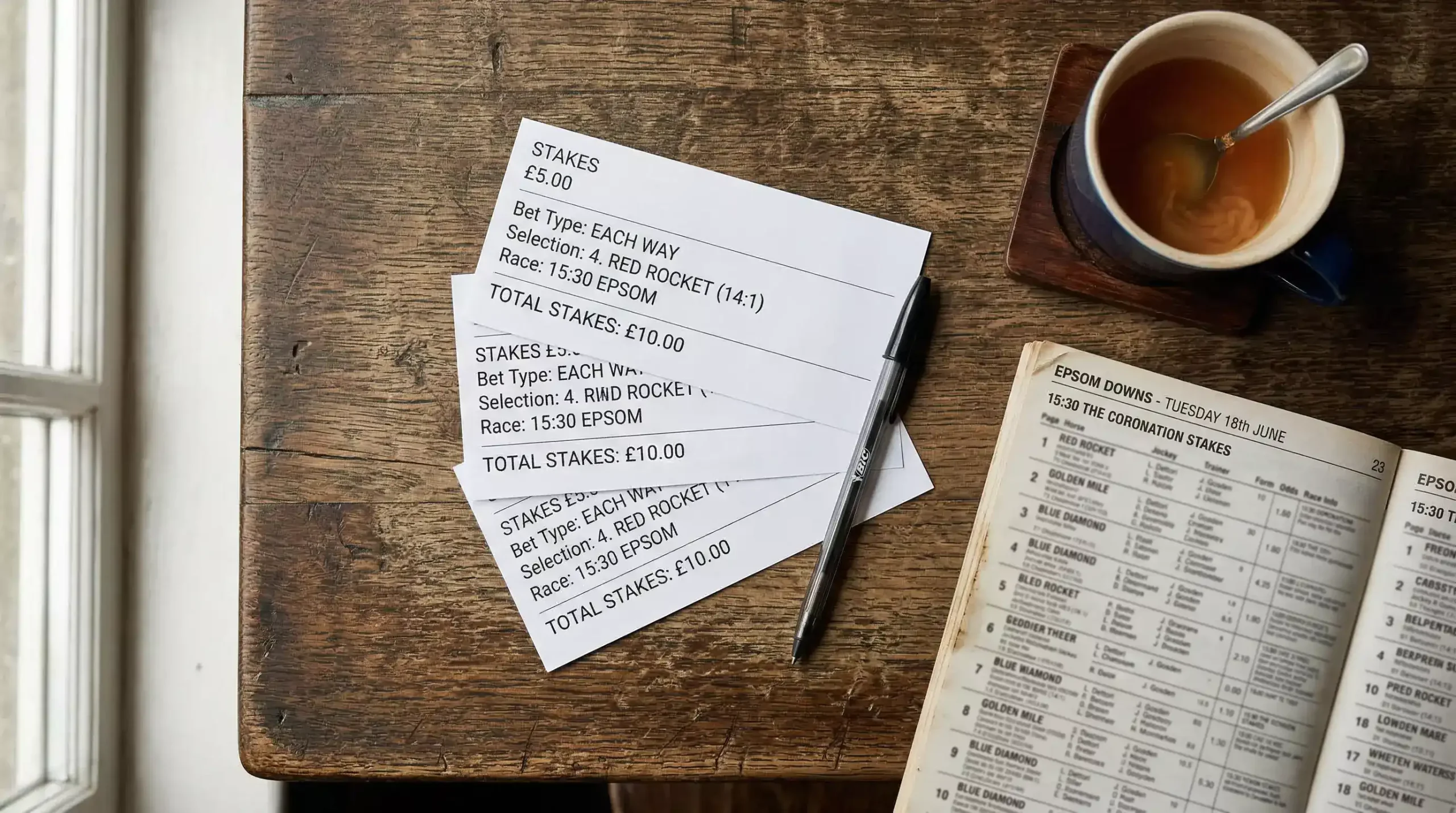
Each-way is the hybrid — two bets in one. Half your stake goes on the win, half on the place. If the horse wins, both halves pay. If it only places, the place half pays at a fraction of the win odds (usually 1/4 or 1/5) while the win half is lost. Data from Receptional’s analysis of Flutter platforms showed that each-way bets surged by 25% at the 2024 Cheltenham Festival, confirming its status as the festival punter’s favourite weapon. Each-way is most effective in large-field handicaps where the place terms are generous and the win odds are long enough for the place return to cover the total stake.
Choosing between these three depends on field size, odds and your confidence. In a small-field race with a standout favourite, a win bet is usually the right call. In a wide-open 20-runner handicap, each-way gives you a realistic route to profit even if your selection does not win. Place-only bets occupy a niche — useful on exchanges, less so with traditional bookmakers where the value is often compressed.
Exotic Bets — Forecast, Tricast and Combinations
Exotic bets take things a step further by asking you to predict not just a winner but a specific finishing order. The payoffs are larger, the difficulty is higher, and the satisfaction of landing one is considerable.
A forecast (also called an exacta) requires you to name the first and second in the correct order. If you think Horse A will win and Horse B will finish second, a straight forecast covers exactly that outcome. A reverse forecast doubles your stake by covering both permutations — A first and B second, or B first and A second. The Computer Straight Forecast (CSF) is the industry-standard payout method for most forecast bets, calculated by an algorithm after the race based on the SP of the placed horses. CSF dividends can be generous, particularly when the first two home are at longer odds.
A tricast extends the principle to three places: first, second and third in the correct order. The difficulty increases exponentially — you are now predicting a precise 1-2-3 finish — but so does the potential return. A combination tricast covers all possible permutations of your three selections across the first three places, meaning six bets from three horses. The cost rises accordingly (six times your unit stake), but the flexibility improves your chances of collecting.
Forecasts and tricasts are particularly popular in handicap races where the form is closely matched and multiple outcomes are plausible. They also appeal to punters who enjoy a deeper level of race analysis — studying pace, draw and likely running styles to predict how the race will unfold from start to finish, not just who crosses the line first. The key discipline is stake management: the temptation with exotics is to over-stake because the potential payout looks enormous, but the strike rate is inherently low. Treating forecasts and tricasts as occasional, calculated bets rather than routine wagers is the sensible path.
Multiples and System Bets — Accumulator to Lucky 15
Multiple bets link two or more selections into a single wager, with the winnings from each selection rolling into the next. The simplest multiple is a double — two selections, both must win. A treble adds a third. An accumulator (or acca) chains four or more selections together, and the potential returns escalate rapidly. Four winners at 3/1, 4/1, 5/1 and 6/1 in a four-fold accumulator turn a £1 stake into a return of £840. The maths is seductive, which is precisely why accumulators are among the most popular — and most losing — bet types in racing.
The catch is probability. Each additional leg in an accumulator multiplies the difficulty. If each of your four selections has a genuine 25% chance of winning, the probability of all four obliging is 0.25 × 0.25 × 0.25 × 0.25 = 0.39%, or roughly one in 256 attempts. That is a harsh reality masked by the headline return figure. Accumulators are entertainment bets for most punters and should be staked accordingly — small amounts, fully expected to lose, with the occasional windfall providing the thrill.
System bets offer a middle ground by covering multiple combinations within a set of selections. A Trixie is four bets on three selections: three doubles and one treble. Two winners guarantee a return. A Patent adds three singles to the Trixie, making seven bets in total — even one winner pays something. A Lucky 15 covers four selections with 15 bets: four singles, six doubles, four trebles and one four-fold. Many bookmakers offer bonuses on Lucky 15s — double odds for one winner, a consolation if all four lose — which can improve the value proposition.
The appeal of system bets is resilience. Unlike a straight accumulator, where one loser wipes out the entire bet, a Trixie or Lucky 15 returns something as long as enough legs win. The trade-off is cost: a Lucky 15 at £1 per line costs £15, and the returns from two or three winners at modest odds may only marginally exceed the outlay. Calculating the break-even point before placing the bet is a habit worth developing.
Pool Bets — Placepot, Jackpot and Scoop6
Pool bets operate on an entirely different model. Instead of betting against a bookmaker at fixed odds, you stake into a communal pool with every other punter, and the total pool — minus the operator’s deduction — is divided among the winners. The Tote (UK Tote Group) runs the main pool betting operation in British racing.
The Placepot is the most accessible pool bet. You need to pick a horse to place in each of the first six races on a card. “Place” here follows standard place terms, so in a large field, the first three or four count. If all six selections place, you share the pool dividend. The Placepot is popular at festivals and big Saturday meetings, where the pools can reach six figures and even a modest unit stake can yield a significant return.
The Jackpot requires you to find the winner — not just a placed horse — in each of the first six races. The difficulty is substantially higher, and rollovers are common, which pushes the pool to eye-catching sums. Scoop6, run by the Tote on selected Saturdays, follows a similar format with a bonus fund for winners who correctly predict a seventh race. With UK racecourse attendance reaching 5.031 million in the most recent BHA figures — a 4.8% year-on-year rise — pool bets benefit from growing on-course participation, where the Tote windows and self-service terminals remain a fixture of the raceday experience.
Pool bets are fundamentally different from fixed-odds betting because your return depends not on the bookmaker’s price but on how many other punters backed the same outcome. An unpopular winner produces a large dividend; a favourite winning reduces it. This dynamic makes pool betting a separate discipline entirely — one where reading the likely popularity of selections matters as much as reading form. For punters who enjoy that extra layer of strategy, the Placepot and its cousins offer something that a standard win bet simply cannot.