
 Available in US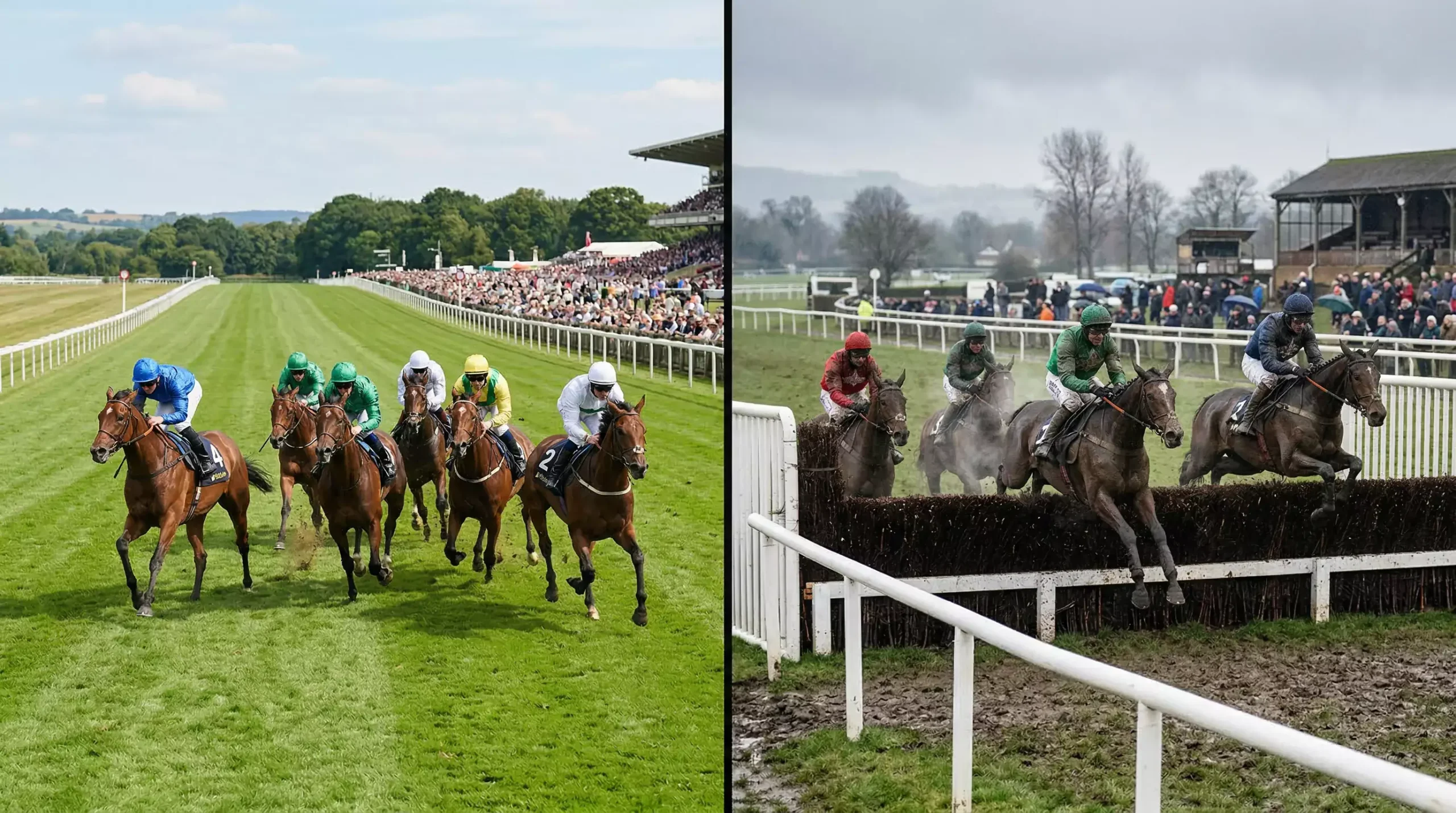
British horse racing operates under two codes, and the distinction matters far more than most casual bettors realise. Flat racing is the sport of speed — young thoroughbreds running on level ground over distances from five furlongs to two and a half miles, typically between April and October. National Hunt, also known as jump racing, is the sport of endurance and courage — older horses tackling hurdles or steeplechase fences over longer distances, with the core season running from October to April.
For punters, this is not just a seasonal split. The two codes produce fundamentally different betting markets. Field sizes, form reliability, the influence of the going, the role of the jockey, the likelihood of non-completions — all of these variables shift depending on whether you are looking at a Flat sprint at Ascot or a three-mile chase at Cheltenham. Understanding those differences is the starting point for betting each code on its own terms rather than applying a one-size-fits-all approach to two codes, two markets.
UK Flat Racing: Season, Tracks and Betting Factors
The Flat season on turf runs from mid-April to early November, though all-weather racing at venues like Wolverhampton, Chelmsford, Newcastle, Kempton and Lingfield fills the calendar year-round. The showpiece events — the 2,000 Guineas, the Derby, the Oaks, Royal Ascot, Glorious Goodwood, the Ebor meeting at York and Champions Day at Ascot — are concentrated in the warmer months and attract the highest-quality fields.
Flat racing is defined by speed and precocity. Horses begin racing as two-year-olds, with some of the most valuable races restricted to juveniles. A horse’s physical development, its breeding profile and the quality of early form all carry significant weight. Because Flat races are run on level ground without obstacles, the variables that determine the result are primarily speed, stamina, the going, the draw and the ability of the jockey to find the right position.
The draw deserves special attention on the Flat. On straight courses, stall position can make or break a race — particularly at venues like Chester, where low draws are heavily favoured in sprints, or Beverley, where the camber of the track creates biases. Draw analysis is a legitimate form study tool on the Flat that simply does not exist in National Hunt racing. If you are betting on Flat sprints without checking the draw statistics for the course, you are ignoring one of the most quantifiable edges available.
Form on the Flat tends to be more reliable in the short term because the risks are lower. Horses do not fall, do not refuse, and do not pull up through exhaustion in the same way that jump horses do. A Flat horse beaten a length into second last time out has a measurable probability of reversing form based on weight changes, going shifts and draw advantages. That predictability makes the Flat a more data-friendly code — which, paradoxically, also makes it harder to find value because the market is priced more efficiently.
National Hunt — Hurdles, Fences and the Winter Game
National Hunt racing is a different animal — literally and figuratively. The horses are older, typically beginning their careers over hurdles at age four or five and progressing to steeplechases as they mature. The distances are longer, ranging from two miles over hurdles to four miles and more over fences. The obstacles add a dimension that Flat racing simply does not have: a horse can be travelling brilliantly and then fall at the second-last, turning a winning bet into a losing one in the space of a stride.
The core jump season runs from October through April, peaking with the Cheltenham Festival in March and the Aintree Grand National meeting in April. Summer jumping exists — there are meetings throughout June, July and August — but the ground is typically faster and firmer than most jump horses prefer, and the quality of the fields is generally lower. The real action belongs to the winter months, when soft and heavy ground sorts the genuine stayers from the pretenders.
The population of jump horses is significant. According to the BHA’s 2025 Racing Report, 21,728 horses were in training across UK racing, a 2.3% decline on the previous year. That contraction is felt more keenly in the jump code, where the physical demands of racing over obstacles lead to higher retirement rates and more career-ending injuries than on the Flat.
For bettors, National Hunt racing introduces variables that require a different analytical lens. Jumping ability is paramount — a horse with electric speed over hurdles will struggle if its technique over fences is poor. Stamina is tested over distances that expose any weakness. And the going has a more pronounced effect: heavy ground at Cheltenham can transform a race, with horses that relish deep ground outperforming faster types that would beat them on a better surface. The best jump bettors are the ones who weigh these variables specifically, rather than treating form analysis as identical to the Flat.
How Code Differences Affect Your Betting Approach
The practical differences between betting on the Flat and betting over jumps are more than cosmetic. They affect how you read form, how you assess value, and how you manage your expectations about strike rates and losing runs.
On the Flat, form is relatively clean. A finishing position in a previous race is a strong indicator of current ability because the hazards are minimal — no fences to fall at, no hurdles to refuse. Form analysis centres on time figures, weight adjustments, draw advantages and going preferences. The data is structured, quantifiable and widely available. This makes the Flat appealing to analytical bettors who prefer spreadsheets to intuition.
Over jumps, form is noisier. A horse that fell three out when leading was not beaten on merit — it encountered a hazard. A horse that pulled up might have been struggling with the ground or might have been suffering from a breathing problem that has since been addressed. Reading jump form requires judgement calls about what the bare figures actually mean, and those calls are subjective in a way that Flat form analysis rarely is. This subjectivity is both the challenge and the opportunity: because the market cannot quantify jumping errors and non-completions as precisely as time figures, mispriced horses are more common.
Seasonality also shapes the betting calendar. On the Flat, the turf season runs roughly April to October, with all-weather plugging the winter gap. The jump season mirrors the opposite calendar. A punter who bets exclusively on one code will have natural fallow periods; a punter who understands both codes can bet year-round without forcing selections in markets they do not understand. The transition months — October and April — are particularly interesting, as both codes overlap and form lines can be cross-referenced between horses moving from summer jumping to the main winter campaign or vice versa.
Field Sizes in Numbers — What the Data Shows
Field size is one of the most underappreciated variables in horse racing betting, and it differs materially between the two codes. BHA data for 2025 shows that the average Flat race had 8.90 runners, while the average jump race had 7.84. At Premier fixtures — the top-tier meetings — the gap widens: Flat Premier races averaged 11.02 runners compared to 9.41 for Jump Premier races.
Larger fields mean more unpredictable outcomes, wider-priced winners and better each-way opportunities. On the Flat, double-digit fields are common in handicaps, particularly on Saturdays and at the summer festivals. This is the terrain where each-way betting thrives, where outsiders land at rewarding prices, and where the favourite’s win probability is diluted by the sheer number of competitors.
In jump racing, smaller fields are the norm, particularly in non-handicap races. A novice chase on a Tuesday afternoon at Fontwell might attract five or six runners. In those small fields, the favourite’s dominance is more pronounced, the odds are shorter, and the each-way market is compressed or non-existent. The betting approach shifts towards win bets on selections you have strong opinions about, rather than each-way speculation across big fields.
This data-driven understanding of field sizes across the two codes should inform every aspect of your betting — from the type of bet you place, to the staking plan you apply, to the markets you target. A punter who understands that Flat handicaps on Premier cards produce the largest, most open fields will naturally gravitate towards each-way bets in those races. A punter who understands that small-field jump novice events favour short-priced specialists will adjust accordingly. The numbers do not lie; they just need reading.
