
 Available in US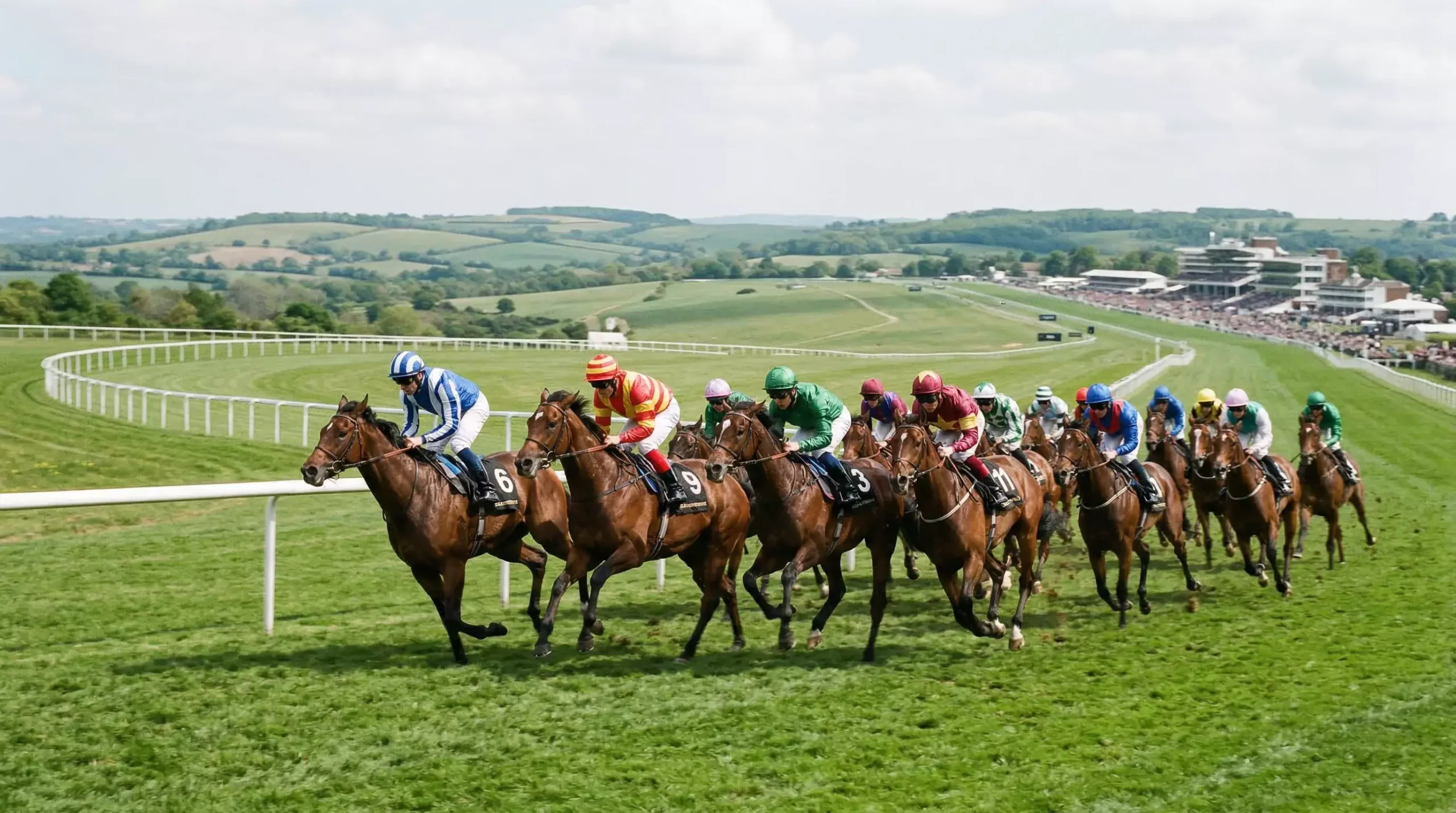
The Epsom Derby is the blue riband of Flat racing — the oldest Classic, the most prestigious middle-distance race in the world, and a contest that has shaped the thoroughbred breed for nearly two and a half centuries. Run over a mile and four furlongs on the first Saturday of June, the Derby tests qualities that no other race demands in quite the same combination: speed, stamina, temperament and the ability to handle a downhill camber at Tattenham Corner that unsettles all but the most balanced horses.
For bettors, the Derby is a fascinating puzzle. The field consists entirely of three-year-olds who have never raced over the trip, never negotiated Epsom’s unique topography, and whose potential is still largely a matter of extrapolation from shorter-distance form. Every Derby is a step into the unknown, and that uncertainty is precisely what creates opportunity in the market.
Race Format — Distance, Conditions and the Epsom Camber
The Derby is run over one mile, four furlongs and ten yards at Epsom Downs, a distance that sits at the heart of the middle-distance spectrum. The field is restricted to three-year-old colts and fillies (though fillies rarely run, having their own equivalent in the Oaks the day before). Maximum field size is typically capped at around 20 runners, though in practice between 10 and 16 usually line up.
What makes Epsom unique is its topography. The course rises sharply from the start for the first half-mile, levels briefly, then descends steeply towards Tattenham Corner — a sweeping left-handed bend that runners take while still travelling downhill. The camber on the bend pushes horses towards the outside rail, and those that lack balance can lose lengths or, in extreme cases, run wide into the straight. The final three and a half furlongs are uphill, and the combination of the downhill descent and the uphill finish creates a test of stamina that the raw distance alone does not suggest.
From that pool of 21,728 horses in training across the UK — according to the BHA’s 2025 Racing Report — only a tiny fraction are bred, trained and qualified to contest the Derby. The entry process begins months before the race, with nominations and supplementary entries narrowing the field as connections assess their horse’s readiness. By declaration day, the field is known, but the question of which horse will handle Epsom remains unanswered until the race itself.
The going plays a heightened role at Epsom. The downhill section becomes treacherous in soft or heavy ground, amplifying the advantage of balanced, athletic horses over long-striding types that prefer to gallop on a level surface. On fast ground, pace tends to be stronger and the true stayers are tested less severely coming up the hill. Checking the going in the days before the Derby — and adjusting your assessment of each runner’s suitability — is an essential part of the preparation.
The Five Classics — Where the Derby Fits
The Derby sits at the centre of the five British Classics — the most historic series of races in Flat racing. The full set comprises the 2,000 Guineas (one mile, Newmarket, late April/early May), the 1,000 Guineas (one mile, Newmarket, fillies only), the Oaks (a mile and a half, Epsom, fillies only), the Derby (a mile and a half, Epsom) and the St Leger (a mile and three-quarters, Doncaster, September). Together they chart the progression of the three-year-old generation across the season, from the speed test of the Guineas to the stamina examination of the St Leger.
The Derby has the highest profile of the five and traditionally the deepest betting market. It is the race that determines the most valuable breeding stallion of the generation — a Derby winner’s stud career can be worth tens of millions of pounds, which is why ownership groups and breeding operations invest so heavily in identifying and preparing Classic contenders. As BHA Director of Racing Richard Wayman noted when reviewing the sport’s performance, major meetings including the Derby and Oaks continued to perform strongly, generating significant revenue for racing and sustaining the sport’s profile with the wider public.
The horse racing industry’s economic contribution — estimated at £4.1 billion to the UK economy — is anchored by events like the Derby that generate media coverage, betting turnover and sponsorship interest beyond the core racing audience. Derby day at Epsom remains one of the most-watched days in British sporting television, and the betting market reflects that exposure. Casual punters who bet once or twice a year gravitate towards the Derby, injecting money into the market that can create pricing inefficiencies for more informed bettors to exploit.
Derby Form — Trials, Breeding and the Unknown Factor
Derby form analysis is unlike any other race in the calendar because the key question — will this horse stay a mile and a half at Epsom? — cannot be answered from the form book. No Derby runner has raced the trip before. The entire exercise is extrapolation: assessing whether a horse that has won over ten furlongs at Newmarket can stretch to twelve furlongs on a course that bears no resemblance to the Rowley Mile.
The trial races are the primary data source. The Dante Stakes at York, the Lingfield Derby Trial on the all-weather, the Chester Vase and the Dee Stakes are the traditional stepping stones. A horse that wins the Dante convincingly has answered the stamina question over ten and a half furlongs on a galloping track — a decent proxy for Epsom’s demands. A Lingfield Trial winner has handled a left-handed bend with a camber on a track designed to mimic Epsom’s profile. Each trial tells you something, but none tells you everything.
Breeding matters more in the Derby than in almost any other race. A horse by a proven stamina sire — one whose progeny consistently win over a mile and a quarter or further — is more likely to see out the Derby trip than one by a pure speed influence. Pedigree analysis is not guesswork; it is data, drawn from decades of results by a sire’s offspring and supplemented by the dam’s own racing record and the performance of her other foals. Bettors who ignore breeding in the Derby are ignoring a significant information source.
The unknown factor is temperament. Epsom on Derby day is an extraordinary environment — vast crowds, intense noise, a parade that lasts several minutes, and a starting stall experience on a steep uphill gradient. Some horses thrive on the occasion; others boil over. A horse that has shown a tendency to be keen or fractious in smaller races may be overwhelmed by the Epsom atmosphere. This variable is difficult to quantify and impossible to predict from form figures alone, which is why the Derby produces surprises more often than most Group 1 races.
Derby Market Patterns — Ante-Post to Race Day
The Derby ante-post market begins in earnest after the 2,000 Guineas in late April or early May. Guineas runners who stayed on strongly — suggesting they want further — shorten for the Derby. Those who weakened in the final furlong are crossed off. The market narrows rapidly as trial results land in May, and by the week of the race, the likely favourite is usually established.
Price movements in the final ten days can be dramatic. A positive piece of work on the Epsom gallops, a trainer’s bullish interview, or a late decision by a supplementary entry to pay the fee and take their chance can all move the market by several points. Equally, a minor setback — a cough in the yard, a disappointing piece of work — can see a horse drift from 5/1 to 10/1 overnight.
On the day, the market is driven by a mixture of informed and uninformed money. The blue riband attracts casual punters who back horses on name recognition, jockey reputation or stable association rather than form analysis. This influx of “public money” can create value for punters who have done the analytical work. A horse that is overbet because of its trainer’s fame may trade at shorter odds than its form justifies, while a less fashionable runner with a strong trial performance and suitable breeding may drift to a price that represents genuine value.
Best Odds Guaranteed is essential for the Derby. The SP frequently moves from the morning price by several points, and BOG ensures you capture any drift without downside. Take a price early, let BOG protect you, and focus your final pre-race analysis on the going report and any last-minute market intelligence that might alter your assessment.
