
 Available in US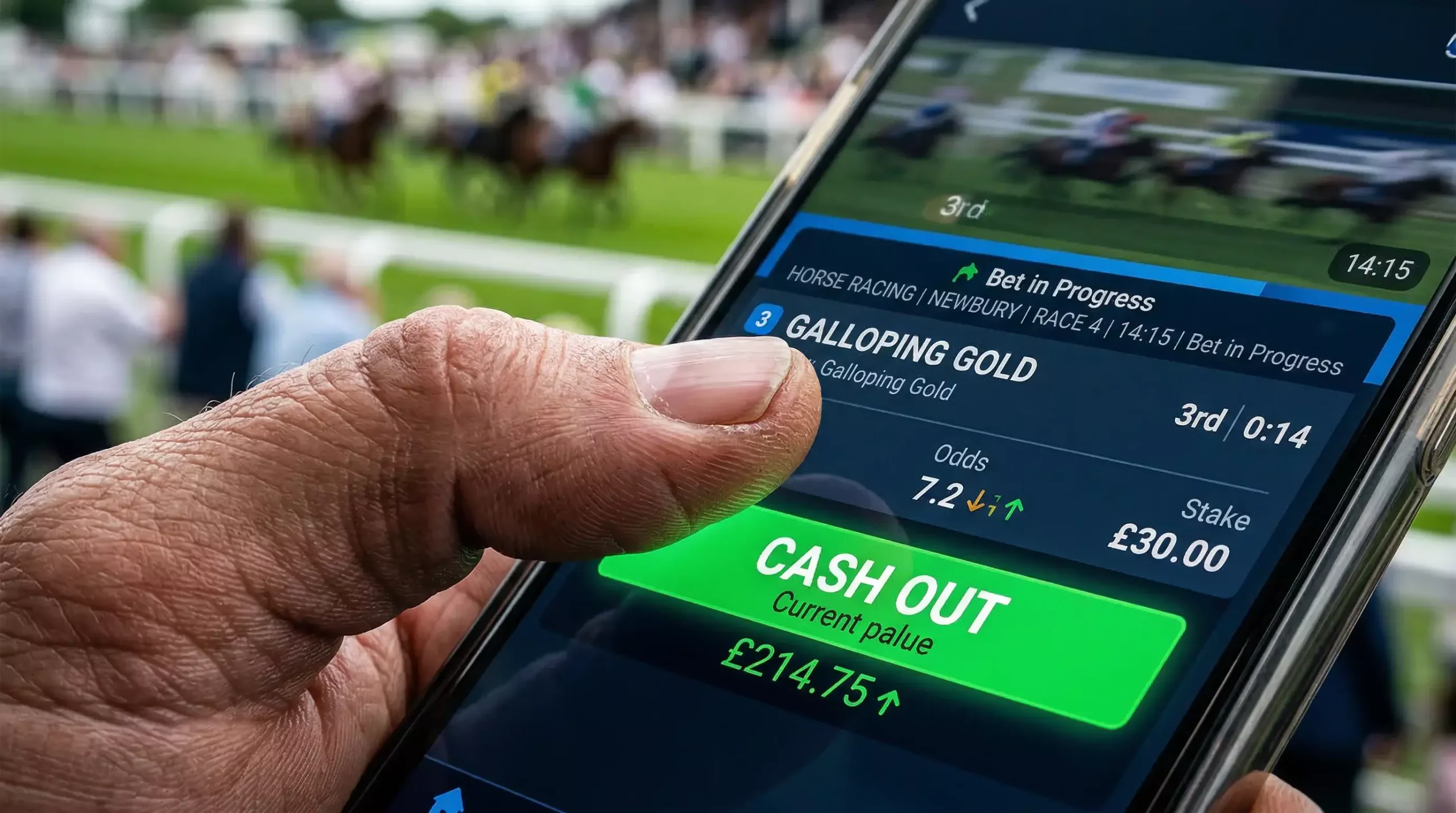
Cash out gives you the option to settle a bet before the race is over — or, in the case of ante-post bets, before the race has even started. If your horse is leading coming into the final furlong, the bookmaker will offer you a cash-out figure that represents a guaranteed profit, smaller than the full return but available right now. If your horse is struggling at the back of the field, the cash-out offer lets you cut your loss and recover part of your stake. It is the ability to close early, trade smart, and exercise control that a traditional let-it-ride bet does not provide.
Cash out has become one of the most-used features in online horse racing betting, driven by the mobile experience where a single tap can lock in a position. But the convenience comes with a hidden cost, and understanding how bookmakers price the cash-out offer is essential before you start using it.
Full Cash Out — Locking In Early
Full cash out settles your entire bet at the bookmaker’s offered price. If you placed a £10 bet at 8/1 and the horse is travelling well during the race, the bookmaker might offer a cash-out value of £55. Accept it, and £55 lands in your account immediately. The bet is closed, and the final result no longer matters. If the horse goes on to win, your full payout would have been £90 — you left £35 on the table. If the horse falls at the last, you banked £55 instead of nothing.
The same mechanism works in reverse. If your horse is struggling, the cash-out value will be less than your original stake — perhaps £3 on a £10 bet. Accepting it salvages a small amount rather than losing the full £10. The decision is binary: is recovering £3 now better than the chance, however slim, of a late rally?
Pre-race cash out works on the same principle. If you backed a horse ante-post at 12/1 and its price has since shortened to 5/1 — perhaps after a convincing trial win — the cash-out offer will reflect the price contraction. You can lock in a profit without waiting for the race to be run, eliminating non-runner risk entirely. With more than 80% of Cheltenham Festival bets placed via mobile, according to Receptional’s analysis of Flutter platforms, the tap-to-cash-out workflow has become second nature for millions of punters.
The decision to cash out is always a trade-off between certainty and potential. Taking the guaranteed figure is rational when the risk of the remaining outcome outweighs the additional return. Leaving it to run is rational when you believe the probability of a better outcome is high enough to justify the risk. There is no universally correct answer — it depends on the race, the position of your horse, and your own risk tolerance.
Partial and Auto Cash Out — Finer Control
Partial cash out lets you settle a portion of your bet while leaving the rest active. If the bookmaker offers a full cash-out of £60 on your £10 bet, you might choose to cash out 50% — banking £30 while leaving half the bet running. If the horse wins, you collect a reduced payout on the remaining portion plus the £30 already banked. If it loses, you have the £30 and forfeit only the uncashed half.
Partial cash out is a genuinely useful tool for managing risk during a race. It allows you to guarantee a profit (or reduce a loss) while retaining exposure to the final outcome. The percentage you cash out is flexible — some bookmakers let you choose any proportion, while others offer fixed increments (25%, 50%, 75%). The key is recognising that each partial cash-out reduces your remaining potential return, so using it repeatedly on the same bet will whittle down your position until little is left to play for.
Auto cash out sets a target value at which the bookmaker will automatically close your bet. If you tell the system to cash out if the value reaches £80, the bet will settle the moment that threshold is hit — without requiring you to be watching the race. This is particularly useful for punters who place ante-post bets and want to lock in a profit if the market moves in their favour, or for in-play situations where you might not have your phone in hand at the critical moment.
The risk with auto cash out is that market conditions can cause the value to spike and drop rapidly, triggering the cash-out at a level that, with the benefit of hindsight, was premature. Setting the target thoughtfully — based on a clear profit objective rather than a round number — reduces the chance of regret.
The Hidden Cost — How Bookmakers Price Cash Out
The cash-out value offered by a bookmaker is not a fair calculation of your bet’s current worth — it is a fair calculation minus a margin. The bookmaker builds a spread into the cash-out price, just as it builds a margin into the original odds. This spread means that the cash-out offer is systematically lower than the theoretical value of your open bet.
Consider a simple example. You have a £10 bet at 8/1 on a horse whose in-play price has moved to 3/1. The theoretical current value of your bet is approximately £22.50 (the ratio of the original odds to the current odds, applied to your potential return). The bookmaker might offer a cash-out of £19 or £20. The gap — £2.50 to £3.50 — is the bookmaker’s cash-out margin. It is how the operator profits from offering you the feature.
The margin varies by bookmaker and by market conditions. As Alan Delmonte, Chief Executive of the Horserace Betting Levy Board, has noted in the context of broader bookmaker profitability, operator margins across horse racing have been notably robust — with February and March 2025 in particular seeing gross profits well above recent norms. Cash out contributes to those margins because it introduces an additional layer of pricing that the punter rarely scrutinises. Gambling Commission data shows the remote casino, bingo and betting sector generated £7.8 billion in GGY — and cash-out margins are embedded within that figure.
This does not mean you should never cash out. It means you should be aware that every cash-out is a transaction where the bookmaker takes a cut. The convenience of closing early comes at a price, and factoring that price into your decision is part of using the feature intelligently rather than reflexively.
When Cashing Out Adds Value — and When It Doesn’t
Cash out adds genuine value in a handful of specific scenarios — and subtracts value in others. Knowing the difference is the practical skill that separates disciplined use from habitual use.
Cash out makes sense when: you have an accumulator with three of four legs won and the final leg is a competitive handicap with no standout favourite. The cash-out value represents a guaranteed return that may be preferable to risking it all on a 50/50 outcome. It also makes sense on ante-post bets where the horse’s price has shortened substantially and you want to lock in a profit while eliminating non-runner risk. And it is valuable when new information — a going change, a negative stable report — has materially reduced your confidence in the selection since you placed the bet.
Cash out subtracts value when: you use it to escape short-term anxiety rather than to respond to genuine information. A horse trailing by three lengths with two furlongs to run is not beaten — plenty of races are won from further back. Cashing out because the stream makes you nervous is an emotional decision, not a rational one, and the bookmaker’s margin on the cash-out offer compounds the cost. Similarly, cashing out a winning single mid-race because you want the dopamine hit of a confirmed profit is almost always worse, in expected-value terms, than letting the bet run to its conclusion.
The best framework is simple: close early, trade smart only when the cash-out decision is driven by information or strategy, never by impulse. If you cannot articulate why you are cashing out beyond “I want the money now,” the feature is costing you more than it is saving.
