
 Available in US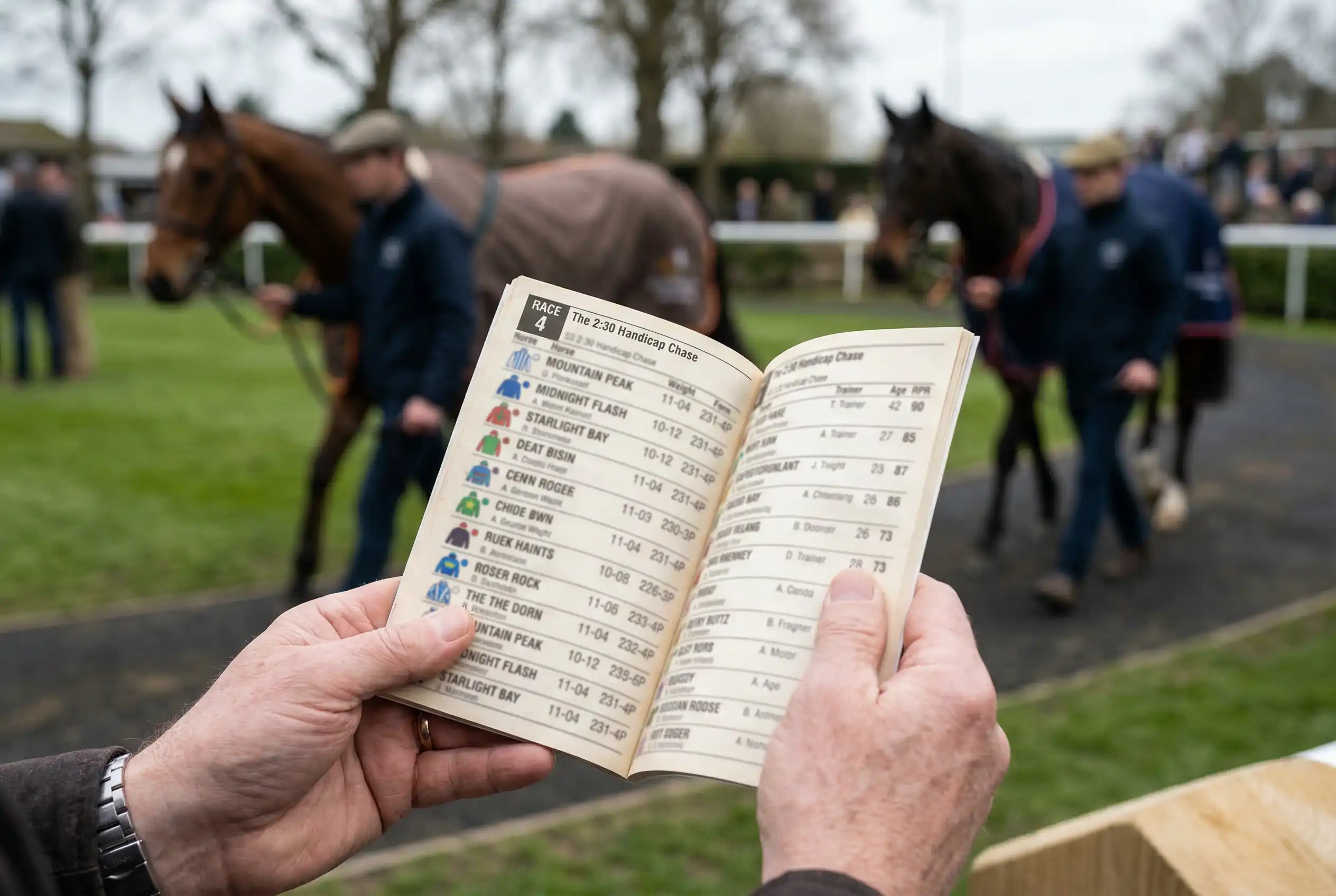
A racecard is the passport to every race. It contains the information you need to assess each runner — its recent form, the weight it carries, the jockey, the trainer, the draw position, and a cluster of abbreviations that look cryptic at first glance but become second nature with practice. Without reading the card, you are betting blind: picking names, colours, or numbers and hoping for the best. That approach has its own charm, but it is not a strategy.
Whether you pick up a printed racecard at the course, open the Racing Post app or browse an online bookmaker’s race page, the core information is the same. The layout may differ, but every card answers the same questions: who is running, what have they done recently, and what conditions are they facing today? Learning to extract that information quickly is the first step towards making informed selections — and it does not require years of experience. A few minutes of guided reading is enough to transform the card from a wall of data into a usable tool.
Once you have analyzed the form figures and trainer stats, you can confidently explore different types of horse racing bets to suit your chosen selection.
Anatomy of a UK Racecard: Form, Weights and Details Explained
Every racecard begins with the race header: the time, the course, the race name, the distance, the class, the going and the prize money. These details frame the contest. A Class 2 handicap over two miles at Cheltenham on soft ground is a fundamentally different proposition from a Class 5 novice hurdle over two miles at Plumpton on good ground — even though the distance is identical. The class tells you the quality of the field; the going tells you the ground conditions; the prize money signals how seriously trainers are treating the race.
Below the header, each runner is listed with a set of core data points. The number and draw appear first. The cloth number identifies the horse on the course, while the draw (on Flat races) indicates the starting stall. On certain courses — Chester and Beverley are classic examples — a low draw or high draw confers a measurable advantage, and this information is readily available in course guides.
The horse’s name follows, often accompanied by its age, sex, and colour. A notation like “b g 6” means bay gelding, six years old. Next to the name, you will often see letters in brackets: CD means the horse has won at this course and distance before, D means it has won at this distance, C means it has won at this course, and BF indicates it was a beaten favourite last time out. These shorthand markers are worth scanning before you read anything else — a horse with a CD tag has already proven it handles today’s specific test.
The weight is listed in stones and pounds. In handicaps, the weight is assigned by the official handicapper based on the horse’s rating — better horses carry more weight, creating a theoretically level playing field. In non-handicap races, weight is determined by age and sex allowances set out in the conditions. The jockey and trainer are named, and on detailed cards, their recent strike rates and course-specific records may also appear. The BHA reports average field sizes of 8.90 runners in Flat races and 7.84 in Jump races, which gives you a sense of how many competitors you are typically assessing on a single card.
The form figures — a string of numbers and letters to the left of or beneath the horse’s name — are the most information-dense element of the card and deserve their own section. Silks colours, the owner’s name, headgear (blinkers, visor, cheekpieces, hood), and equipment changes (tongue tie, first-time headgear) round out the card. Headgear changes in particular are worth noting: a horse wearing blinkers for the first time is a deliberate tactical decision by the trainer, often signalling that the horse needs help concentrating.
Decoding Form Figures (1-2-3-0-P-F-U)
Form figures are the racecard’s shorthand biography of a horse’s recent performances. They are read from left to right, with the most recent run on the far right. A typical form line might look like this: 21304P2. Each character represents one run, and each character tells you what happened.
1 means the horse won. 2 means it finished second. 3 means third. Numbers up to 9 indicate the finishing position. 0 means the horse finished tenth or worse — outside the frame, effectively nowhere. P means it pulled up, which in jump racing usually signals the horse was struggling, though occasionally a jockey pulls up to protect an injured horse. F means it fell. U means the jockey was unseated — the horse did not fall, but the rider parted company. R means it refused (typically at a fence or hurdle), and B means it was brought down by another horse’s fall.
So our example — 21304P2 — reads as follows, starting from the oldest run: second, first, third, tenth or worse, fourth, pulled up, second. The most recent performance was a second-place finish, preceded by a pulled-up run, which might suggest the horse bounced back from a bad experience. The win (1) was three runs ago, and the horse has placed in three of its last seven starts. That is a decent profile in a handicap — consistent enough to be competitive, with proven ability to win.
A forward slash / in the form line indicates a break between seasons. A form line of 1/213 means the horse won its last run of the previous season, had a break, and has since finished second, first and third in the current campaign. The length of the break matters — a horse returning from a 200-day absence is a different proposition from one that had a routine six-week gap between starts.
Dashes between figures sometimes appear on certain platforms and serve the same purpose as the slash, separating different seasons or campaigns. The key discipline when reading form is recency: the most recent figures carry the most weight, but the overall pattern — consistency, improvement, decline — tells the fuller story. A horse whose form reads 876521 is clearly improving. One whose form reads 125689 is going the wrong way.
Going, Draw and Course — The Hidden Variables
The going — the condition of the ground — is one of the most influential variables in horse racing, and it is stated on every racecard. The official going scale in the UK runs from Hard through Firm, Good to Firm, Good, Good to Soft, Soft, to Heavy. On all-weather surfaces, the equivalents are Fast, Standard to Fast, Standard, Standard to Slow, and Slow. Some horses thrive on fast ground and cannot act on soft; others relish heavy going and struggle when the ground dries out. Ignoring the going is like ignoring the weather forecast before a cricket match.
Going preference is visible in the form figures if you dig a little deeper. A detailed racecard — the kind available on the Racing Post or Timeform — will show the going for each past run. If a horse has form figures of 1-1-2 on soft ground and 0-7-8 on good to firm, the pattern is self-evident. Today’s going should be cross-referenced against each runner’s going record before you form an opinion. With 21,728 horses in training across the UK according to the BHA’s 2025 Racing Report, the population is large enough that going preferences vary enormously — even among horses from the same stable.
The draw is the starting stall position assigned to each horse in a Flat race. On straight courses, the draw can confer a significant advantage depending on where the ground is fastest. At Chester, a tight left-handed oval, low draws have a well-documented edge in sprint races. At Goodwood, the topography means certain draws are favoured depending on distance. In National Hunt racing, there is no draw — horses line up across the course and positioning is down to the jockey.
Course characteristics matter, too. A stiff uphill finish at Cheltenham favours horses with stamina. A flat, galloping track like Newmarket rewards long-striding types. A sharp, undulating track like Epsom demands balance and agility. Reading the card means reading the course — understanding how its quirks interact with each horse’s running style, stamina profile and going preference.
Putting It Together — From Racecard to Bet Slip
Reading the card is a skill that improves with practice, but you do not need to master every element before placing an informed bet. Start with the three questions that matter most: has this horse run well recently (form figures), does it suit today’s conditions (going and course), and is it well-treated by the handicapper (weight and class)?
A practical workflow looks something like this. Scan the form figures for each runner. Eliminate horses with consistently poor recent form — three or more runs outside the first four is a red flag unless there is a clear excuse. Check the going: cross off any horse with a proven aversion to today’s ground conditions. Look at the trainer and jockey — is this a combination that wins at this course? Note any headgear changes or equipment additions that might signal intent.
From the remaining runners, look at the weight and handicap mark. In a handicap, a horse carrying less weight than its rivals has a theoretical advantage, but only if the handicapper has not simply rated it lower because it is less talented. A horse dropping in class — running in a lower grade than its last few races — is often a more reliable angle than a horse carrying a light weight in a class above its level.
Finally, check the odds. The market is not infallible, but it aggregates the opinions of thousands of punters and the pricing of professional bookmakers. A horse that your racecard analysis says should be competitive but is available at double-digit odds might represent value. A horse that looks average on the card but is a warm favourite might be over-bet on reputation alone. The racecard gives you the data; the odds give you the price; and the gap between the two is where informed betting begins.
Make sure to place your wagers through a trusted and licensed online horse racing bookmaker for the safest betting experience.
