
 Available in US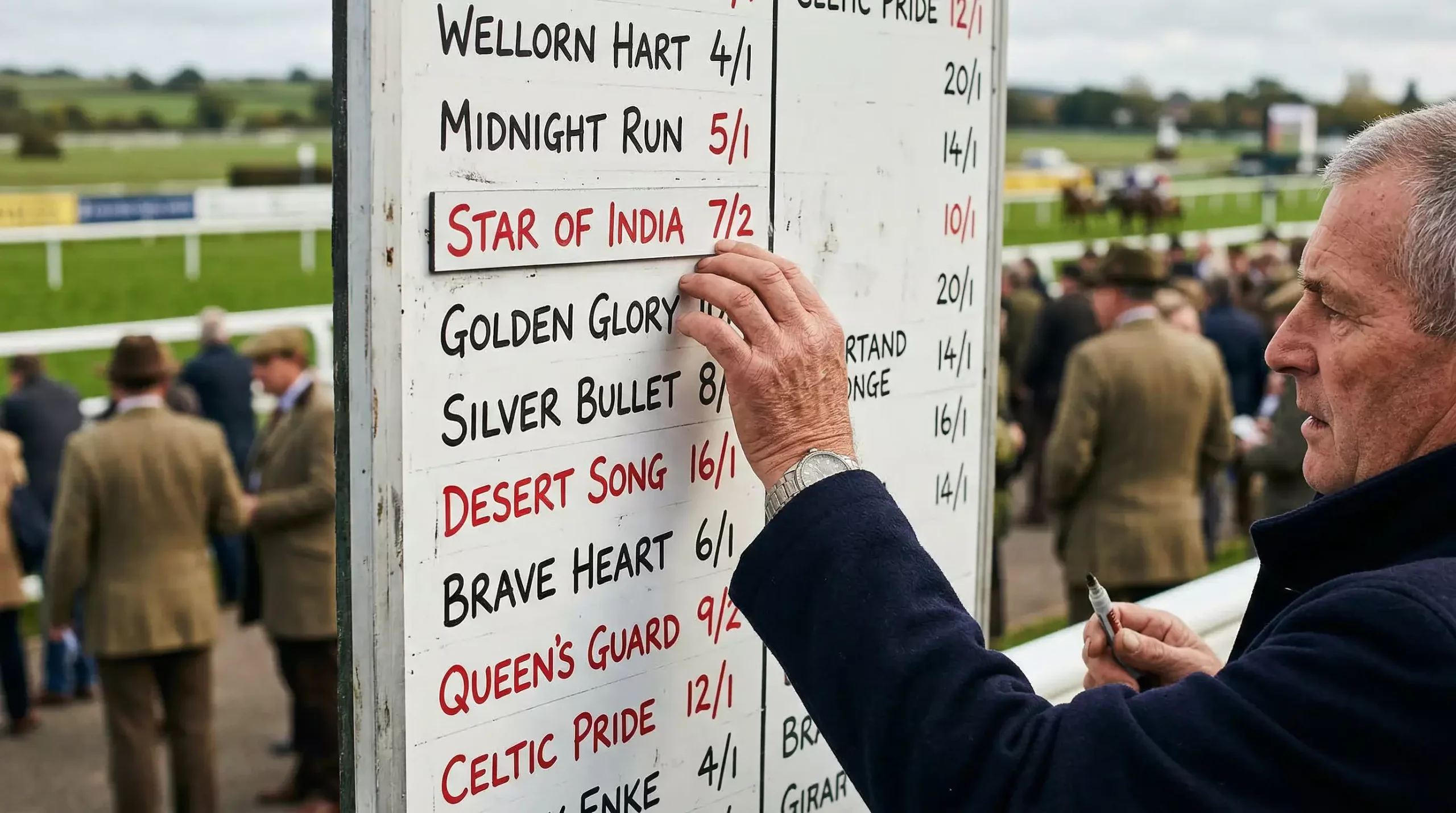
Every horse racing bet begins and ends with a number — the odds. They tell you how much you stand to win, how the market rates a horse’s chance, and, if you know how to read them, whether the price on offer is worth taking. In a sport that generates £766.7 million in remote gross gambling yield across the UK, understanding how odds work is not an academic exercise. It is the difference between punting with your eyes open and punting blind.
Three formats dominate: fractional, decimal and the Starting Price. Fractional odds are the traditional British way of expressing a price and remain the default on most UK racecourses and betting shop screens. Decimal odds have gained ground through online platforms and exchange betting, while the Starting Price — SP — serves as the official market settlement figure at the off. Each format tells you the same thing in a different language, and reading the price fluently in all three gives you a practical edge when comparing bookmakers, spotting value and placing bets at speed.
Fractional Odds: Understanding the Traditional UK Betting Format
Fractional odds are the language of British racing. When a commentator says a horse is “five to one” or a racecard shows 5/1, the meaning is direct: for every £1 you stake, you win £5 in profit if the horse obliges. Your total return is £6 — the £5 profit plus your original £1 stake. At 10/1, a £1 stake returns £11. At 1/2, it returns £1.50. The number on the left is profit; the number on the right is your stake.
Where fractional odds get slightly trickier is with prices like 11/4, 9/2 or 100/30. These are not intuitive at first glance, and many newcomers stumble here. The rule is the same — divide the left by the right, then multiply by your stake. At 11/4, a £4 bet returns £11 profit plus the £4 stake = £15. If you prefer to think in pounds-per-pound terms: 11 divided by 4 = 2.75, so every £1 staked returns £2.75 in profit. Once you internalise that calculation, even the oddest-looking fractions become readable in seconds.
Prices shorter than even money are expressed with a larger number on the right. A 4/6 shot (sometimes written as 4-6 or described as “six to four on”) means you must stake £6 to win £4 profit. These are the market leaders — the horses the bookmakers expect to win most often. Odds-on favourites win regularly, but the returns are thin, which is why many experienced punters look further down the card for value. The tradition of fractional odds runs deep in UK racing culture. Bookmakers on the rails at Ascot still chalk prices in fractions, and live commentary invariably uses the format. Even as decimal odds gain digital market share, fractions remain the default at British racecourses.
One practical point: bookmakers sometimes display certain prices differently while meaning the same thing. You might see 6/4 listed as 3/2 on one site and 6/4 on another. They are identical — both pay £1.50 profit per £1 staked. When comparing odds across bookmakers, it helps to reduce fractions to their simplest form or convert to decimal for a like-for-like comparison.
Decimal Odds, American Lines and Conversion
Decimal odds do away with the fraction entirely. Instead of showing profit relative to stake, they show total return per £1. A horse at 5/1 fractional becomes 6.00 decimal. A 10/1 shot is 11.00. An even-money chance is 2.00. The conversion is simple: divide the fraction (left by right), then add 1. So 11/4 becomes (11 ÷ 4) + 1 = 3.75.
The popularity of decimal odds has grown alongside online betting and exchange platforms. Betfair, for instance, defaults to decimal, and many European-facing sportsbooks do the same. The advantage is clarity — at a glance, you see your total return rather than having to mentally separate profit from stake. When you are comparing prices across multiple bookmakers in a fast-moving ante-post market, decimal notation saves time and reduces errors.
American odds, also called moneyline odds, are less relevant to UK racing but worth understanding if you use international platforms. They come in two flavours: positive and negative. A positive number (say, +500) tells you how much profit a £100 stake would yield — in this case, £500. A negative number (say, -150) tells you how much you need to stake to win £100 profit. The system is intuitive for US sports bettors but rarely appears on British racecards. If you encounter it on a global betting exchange or an American sportsbook offering UK racing, converting to decimal is the fastest route to clarity: for positive odds, divide by 100 and add 1; for negative odds, divide 100 by the absolute value and add 1.
In practice, most UK punters will toggle between fractional and decimal depending on the platform. The conversion becomes second nature after a few meetings, and the key takeaway is the same regardless of format: the number represents value, and comparing it accurately across bookmakers is where profit lives.
Starting Price (SP) — How the Market Settles
The Starting Price — universally abbreviated to SP — is the official odds at which a horse is returned at the moment the race begins. It is determined by on-course bookmakers and acts as the benchmark for any bet placed at SP rather than at a fixed price. If you tick “SP” on your bet slip, you accept whatever price the market settles on at the off. You will not know your exact return until the race starts.
SP is calculated by an independent body, the Starting Price Regulatory Commission, based on the prices offered by on-course bookmakers in the ring. The process is designed to reflect genuine supply and demand at the track. In theory, it captures the wisdom of the market at its final moment — the point at which all available information about the horse, the going, the jockey booking and the state of the ground has been absorbed into the price.
Why would anyone bet at SP rather than locking in a fixed price? Two reasons. First, if you believe a horse will drift — that is, its odds will lengthen between the time you place the bet and the off — then SP gives you a bigger return than the early price. Second, some punters prefer SP for convenience, especially when betting on multiple races throughout a meeting. They trust the market and would rather not spend time monitoring price movements across six or seven bookmakers. For bettors who take early prices, though, Best Odds Guaranteed (BOG) offers the best of both worlds — the bookmaker pays the higher of your fixed price or the SP.
Market dynamics matter here. According to the BHA’s 2025 Racing Report, turnover on Premier racing fixtures rose 1.1% while Core fixtures saw an 8.1% decline. That gap reflects where the betting money — and therefore market liquidity — is concentrated. On a Premier fixture with strong media coverage and large fields, the SP is formed by a deep, competitive on-course market. On a quiet Monday afternoon at a minor track, fewer on-course bookmakers may be operating, and the SP can be less reflective of true value. Knowing when to take a price and when to leave it to SP is a skill that develops with experience.
From Odds to Probability — Spotting the Overround
Every set of odds implies a probability. A horse at 4/1 (5.00 decimal) has an implied probability of 20% — the market is saying, in effect, this horse wins one race in five. The formula is straightforward: divide 1 by the decimal odds, then multiply by 100 to get a percentage. At 2.00 (even money), the implied probability is 50%. At 11.00 (10/1), it is 9.09%.
Here is where things get interesting. If you add up the implied probabilities of every horse in a race, the total will exceed 100%. It might come to 115%, 120% or even higher in a large-field handicap. The amount by which the total exceeds 100% is called the overround, and it represents the bookmaker’s built-in margin. A 120% book means the bookmaker has, in theory, a 20% edge before a single bet is settled.
The overround varies by race type, by bookmaker and by how competitive the market is. A high-profile Group 1 race at Royal Ascot might carry an overround of 108-112% because bookmakers compete aggressively for punter money on the big events. A low-profile seller at a weekday meeting might sit at 125% or more because fewer punters are watching, fewer bookmakers are competing, and the margin can be wider without anyone noticing.
For the punter, the overround is the tax you pay for the privilege of betting. Reducing it is one of the most effective long-term strategies available. Shopping for the best odds across multiple bookmakers — a habit made effortless by odds comparison sites — effectively narrows the overround you personally face. If one bookmaker offers 7/1 and another offers 8/1 on the same horse, taking the 8/1 means you are reading the price at a lower margin. Over hundreds of bets, that difference compounds into real money.
Understanding implied probability also helps you spot value. If your own assessment gives a horse a 25% chance of winning and the bookmaker’s odds imply only a 15% chance, you have found what professionals call an overlay — a bet where the true probability exceeds the market-implied probability. Whether you back that horse or not depends on your confidence in your analysis, but recognising the overlay is the first step. Without converting odds to probability, you are comparing prices without knowing what they mean.
