
 Available in US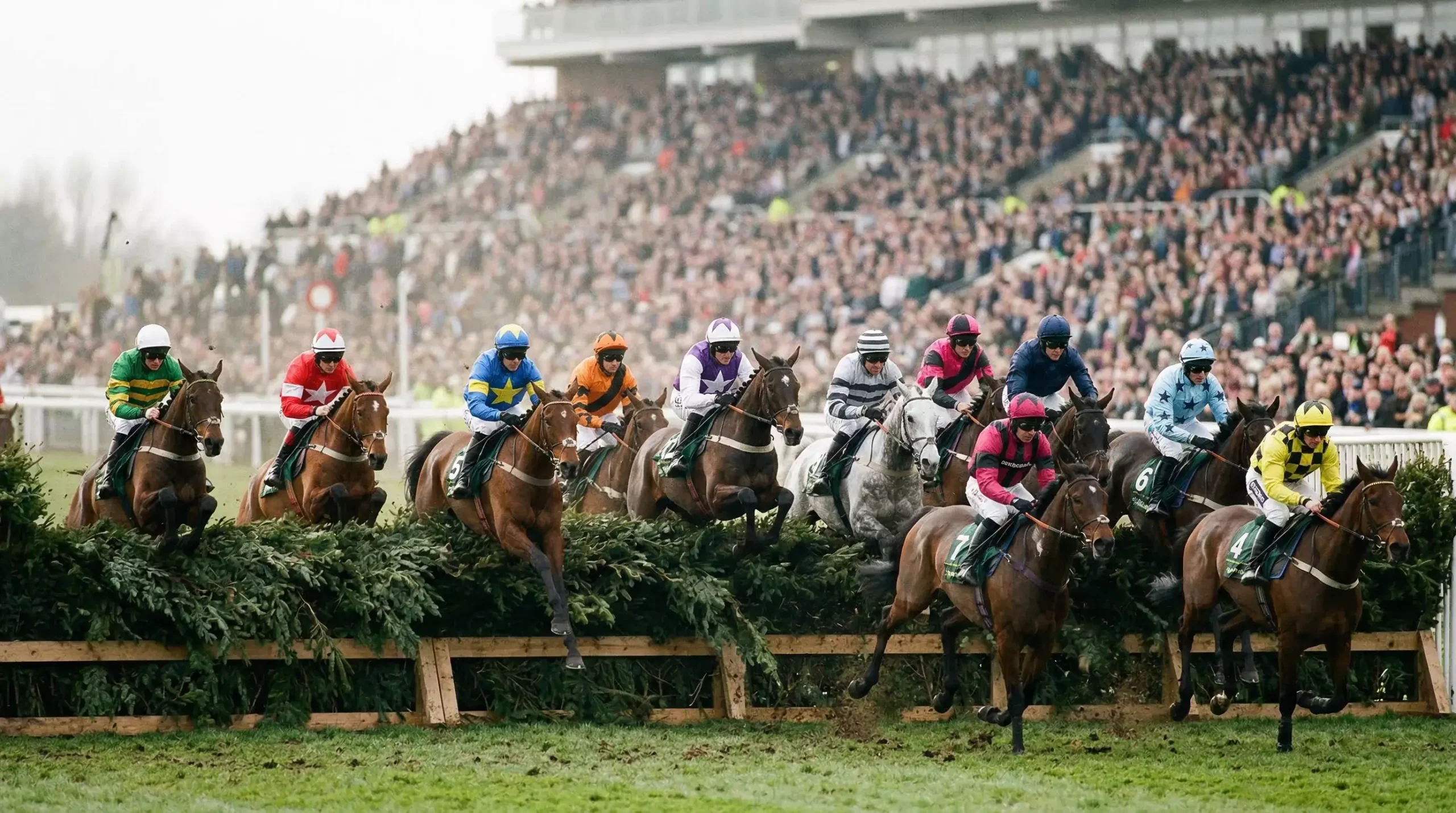
There are roughly 1,460 race meetings staged in Britain every year. One of them stops the country. The Grand National at Aintree, held on a Saturday afternoon in April, generates more betting volume than any other single race in the calendar — and it is not particularly close. Industry estimates put the total wagered on the race itself above £200 million, with the three-day Aintree Festival as a whole attracting upwards of £250 million in stakes. A global television audience of around 600 million, from over 140 countries, watches the field jump thirty fences over four miles and two furlongs of the most demanding steeplechase course in the world.
What makes the National unique is its dual identity. For the once-a-year punter — the person who bets on this race and nothing else — it is a lottery wrapped in spectacle, a chance to back a name they like at 33/1 and dream for four minutes. For the serious bettor, it is something altogether more interesting: a large-field handicap over an extreme distance with identifiable trends, quantifiable variables and a betting market that often misprices horses because of the sheer volume of casual money flowing in. The National market accommodates both audiences, and this guide is aimed at everyone between them.
Whether you are placing your only bet of the year or your five hundredth, the fundamentals are the same: understand the race, understand the market, and place your bet on the best available terms.
Grand National Race Format: Distance, Fences and Handicap System
The Grand National is a handicap steeplechase run over a distance of four miles, two furlongs and 74 yards — roughly four and a half miles. It is the longest race in the top tier of British Jump racing, and the distance alone eliminates a large percentage of the thoroughbred population. A horse needs exceptional stamina just to complete the course, let alone compete for the win. The field is capped at forty runners, though the final number is often slightly smaller after late withdrawals, and they negotiate thirty fences over two circuits of the Aintree Grand National course.
The fences are what give the race its character. They are constructed differently from standard steeplechase fences, with a core of spruce packed over a frame of timber. Over the decades, the obstacles have been modified extensively to improve safety — the drops on the landing side have been levelled, the fences themselves reshaped — but they remain formidable tests of jumping accuracy and bravery. Becher’s Brook, The Chair and the Canal Turn are the most famous, each presenting a specific challenge that has defined the race for generations.
Becher’s Brook, jumped on the first and second circuits, has a steep drop on the landing side that catches out horses who jump too boldly. The Chair is the tallest fence on the course and is only jumped once, on the first circuit, in front of the grandstands. The Canal Turn requires horses to jump and immediately turn left at nearly ninety degrees — a manoeuvre that demands balance and awareness from both horse and jockey.
As a handicap, each horse carries a weight determined by the BHA handicapper, based on its official rating. The top-rated horse carries the most weight, and the difference between the highest and lowest weight in the field can be more than two stone. The theory is that weight levels the playing field, giving lower-rated horses a genuine chance against their superiors. In practice, the National’s extreme distance and unique fences mean the handicap is only one factor among many. Stamina, jumping ability, temperament and luck all play at least as significant a role.
The BHA’s 2025 Racing Report recorded 21,728 horses in training across Britain — a figure that continues a gradual annual decline. Of those thousands, only a fraction have the combination of rating, stamina and experience to qualify for the Grand National. Getting into the race is an achievement in itself. Winning it requires a horse to be good enough, fit enough, brave enough and lucky enough on the day.
Entry follows a multi-stage process: an initial entry phase (typically in February), followed by the weights announcement, then a series of forfeit stages that progressively narrow the field. The final declarations, confirming the runners, are made 48 hours before the race. Between the weights being announced and the race itself, the market shifts substantially — sometimes violently — as horses are withdrawn, ground conditions change and stable confidence becomes public knowledge.
The race begins with a standing start, the field released from behind the tape by the starter. The early stages are often chaotic, with forty horses funnelling into the first fence at speed, jockeying for position. Experienced jockeys aim to settle towards the middle or outer of the field, avoiding the scrimmage on the inside rail where fallers can bring down other runners. By the time the field reaches the Melling Road crossing — a gap in the fences where the course crosses a public road — the pack has usually thinned, with the stragglers and the fallers already out of the picture. The second circuit is where the race truly begins. Tired horses make mistakes, and the fences that were jumped cleanly first time around become more hazardous as fatigue accumulates. The run-in from the final fence to the winning post is 494 yards — a long, draining stretch that has decided many a National in the closing strides.
How the Grand National Became the World’s Most Famous Race
The race that would become the Grand National was first run at Aintree in 1839, though earlier editions at the course date back to 1836 under different names. It grew rapidly from a local steeplechase into a national institution, aided by the rise of the railways, the expansion of the betting industry and, eventually, mass media. By the mid-twentieth century, it was among the most-watched sporting events on British television.
Certain names punctuate the history with an emphasis that no amount of statistics can replicate. Red Rum, who won three Nationals and finished second twice between 1973 and 1977, remains the most famous racehorse in British popular culture — a status that transcends the sport entirely. Aldaniti’s victory in 1981, ridden by Bob Champion after both horse and jockey had recovered from career-threatening illness and cancer respectively, became a film. And the 1967 race, in which a loose horse caused a pile-up at the twenty-third fence and left Foinavon, a 100/1 outsider, to pick his way through the chaos and win, gave English sport one of its most improbable stories.
The Grand National’s cultural reach extends well beyond the racecourse. It is one of only two horse races — the other being the Epsom Derby — on the UK’s protected events list, meaning it must be broadcast on free-to-air television. According to evidence submitted by the BHA to the House of Commons Library, the racing industry generates a total annual contribution of £4.1 billion to the UK economy in direct, indirect and associated expenditure — and the National is the single most visible expression of that economic footprint.
Safety has been the dominant narrative of the National’s recent evolution. Following criticism of equine fatalities, significant modifications were made to the course from 2012 onwards: fences were softened, take-off boards repositioned and the maximum field size reduced from forty to forty runners with tighter eligibility criteria. The introduction of a minimum handicap rating for entry, combined with improved veterinary protocols and course management, has measurably reduced falls and injuries without, by most accounts, diminishing the spectacle. The completion rate has increased significantly over the past decade, with the majority of runners now finishing the race. The modern National is still a test of extraordinary endurance and courage. It is just a fairer one.
The National’s place in British culture is difficult to overstate. Office sweepstakes are drawn, families gather around the television, and people who know nothing about racing confidently offer their opinions on whether a nine-year-old carrying eleven stone seven over four and a half miles of the most demanding fences in the sport has any chance of staying on its feet. That annual ritual of national engagement is what sustains the race’s commercial power and, by extension, the enormous betting market that surrounds it.
Betting the Grand National — Ante-Post to Day-of-Race
The Grand National betting market opens earlier and runs longer than almost any other race in Britain. Ante-post prices are available months before the race, and the market evolves through several distinct phases, each offering different opportunities and risks.
Ante-Post Phase
From the initial entries in February through to the final declarations two days before the race, the ante-post market is the main arena. Prices here tend to be longer than on race day, reflecting the uncertainty about which horses will actually run. The risk is straightforward: if your selection does not line up, you lose your stake. No run, no refund — that is the standard ante-post rule. However, many bookmakers now offer Non-Runner No Bet (NRNB) or Non-Runner Money Back (NRMB) on the Grand National in the weeks leading up to the race. This removes the primary downside of ante-post betting while still allowing you to take an early price, and it is one of the most valuable promotions available.
The ante-post market for the National is shaped by specific milestones: the weights announcement (which can cause significant price movements for horses at the top and bottom of the handicap), the forfeit stages (which remove horses and tighten the market), and the five-day declarations. Each milestone provides an opportunity to reassess your position and, potentially, to find value that the market has not yet priced in.
Day-of-Race Betting
On race day itself, the market is driven by volume. More than eighty per cent of bets on the Grand National are placed at stakes of £5 or less — a reflection of the enormous number of casual punters who bet on this race and no other. That casual money tends to concentrate on horses with memorable names, eye-catching colours or the endorsement of a newspaper tipster. It does not tend to flow towards nuanced form analysis. For the bettor who has done their homework, this creates pockets of value: horses whose price drifts not because of any deterioration in their chance, but simply because the market’s attention is elsewhere.
The going — the condition of the ground — is perhaps the single most important variable on Grand National day. Aintree can ride anywhere from good to firm in a dry spring to soft or heavy after sustained rain, and the difference matters enormously over four and a half miles with thirty fences. Some horses are proven soft-ground specialists; others need a sound surface. Check the going report on the morning of the race, cross-reference it with your selections’ track records, and adjust accordingly.
Each-Way Strategy
The Grand National is the quintessential each-way race. A field of up to forty runners, with standard each-way terms typically paying the first four places at one-quarter the odds, creates a market where place returns can be substantial. A £5 each-way bet (total stake £10) on a 20/1 shot returns £30 for the place element alone if the horse finishes in the first four. Some bookmakers extend their place terms for the National to five or even six places, which further improves the value of each-way bets.
Selecting an each-way contender is a different exercise from picking a winner. You are looking for a horse with a realistic chance of completing the course and finishing in the frame, even if it is not quite good enough to win. Proven stamina over extreme distances, previous experience of Aintree fences and a weight that the horse can handle comfortably are the key criteria. Fancied horses that carry too much weight sometimes struggle to win but still place — making them better each-way propositions than win-only bets.
Grand National Odds and Market Patterns
The National market is unlike any other in racing, and understanding its patterns is essential to betting on it successfully.
The sheer scale of wagering activity sets it apart. According to data compiled by Entain, the Grand National attracted 700 per cent more bets than the Cheltenham Gold Cup in 2024 — a statistic that illustrates just how far the race’s reach extends beyond the regular racing audience. That volume of activity, much of it from infrequent bettors, creates a market with distinctive characteristics.
First, favourites have a mixed record. The Grand National produces more big-priced winners than a standard handicap because the extreme distance and unique fences introduce variables that pure form cannot fully account for. That said, the market is not a random number generator. Five of the last six winners have started at 11/1 or shorter, suggesting that while upsets happen, the fancied horses still win more often than casual observers assume. Backing every favourite blindly would not be profitable, but dismissing them entirely would be worse.
Second, the market tends to shorten ante-post favourites too aggressively as the race approaches. A horse that is 14/1 in February might be 8/1 by race day, not because new information has emerged but because the casual money piling in on well-known names pushes prices down. If you identified value at 14/1, taking the early price — particularly under NRNB terms — is almost always the better approach.
“The Grand National is an integral part of the trading year and traditionally the race that generates the highest turnover,” said Sharon McHugh, Head of Communications and Sponsorship at BoyleSports. “It’s also the one opportunity to engage the non-racing public.” That engagement is precisely what distorts the market. When thirty per cent of people placing a Grand National bet are doing so for the first time — or for the first time since the previous year — the weight of uninformed money creates opportunities for those who have studied the form.
The range of betting options extends well beyond win and each-way. Without-the-favourite markets, top-trainer bets, first-fence fallers, nationality of winner and finishing-position specials are all available with major bookmakers. These novelty markets carry wider margins than the win market, and their value is generally lower, but they offer a way to engage with the race without committing to a single horse as a winner.
One final pattern: course experience correlates with performance. Horses that have run over the Grand National fences before — whether in the Topham Chase, the Bechers Chase or a previous National — have a statistically better record of completing the course and finishing in the frame. First-timers over the fences are not excluded from contention, but they carry additional risk, and the market does not always reflect that.
Where to Bet on the Grand National Online
The Grand National is the one race where every bookmaker in the country raises its game. Promotional budgets are at their peak, odds competition is fierce, and each-way terms are stretched to their most generous. Choosing the right operator for the National is not just about finding the best price — it is about combining odds, terms and features into the best overall package for your bet.
Each-Way Places
This is the headline differentiator. Standard each-way terms on a race with forty runners pay four places at one-quarter the odds. For the Grand National, several major bookmakers extend this to five, six or even more places. The difference between four-place and six-place terms on a 20/1 each-way selection is significant: you have two additional chances of collecting a place return, and in a race where completing the course is uncertain, those extra places have real value. Check the each-way terms offered by your preferred bookmakers before race day, and if one operator is offering materially better terms, that is where your each-way bets should go.
Best Odds Guaranteed
BOG is standard across most major operators for the Grand National, but it is worth confirming. If you take 16/1 on a horse in the morning and it starts at 20/1, BOG ensures you are paid at the higher price. Given that prices on Grand National day move more dramatically than in almost any other race — driven by the influx of casual money — BOG protects you against your selection drifting to a bigger price after you have backed it.
Non-Runner No Bet
For ante-post bets, NRNB is the most valuable feature available. The Grand National has a higher rate of withdrawals between entry and race day than a typical handicap, because horses are often entered speculatively and connections may redirect them to other races. NRNB removes the risk of losing your stake to a non-runner, making it feasible to take an ante-post price with confidence.
Free Bets and Promotions
The National attracts more promotional spend than any other racing event outside the Cheltenham Festival. Free bet offers, money-back specials (such as refunds if your horse falls at the first) and enhanced odds on selected runners are widely available. As with any promotion, the terms and conditions are the substance — not the headline figure. A £20 free bet that requires a £20 qualifying stake at minimum odds of 1/2, with the free bet stake not returned with winnings, is a fundamentally different proposition from a £20 risk-free bet. Read the details before committing.
In-Play and Streaming
ITV broadcasts the Grand National live on free-to-air television, so access to a bookmaker stream is not essential for viewing. However, the in-play markets during the race — where available — provide a different experience. Watching the race through a bookmaker’s app with the cash-out option live is a qualitatively different experience from watching on television with a paper slip in your pocket. Some bookmakers offer in-play betting on the National; others do not. If in-play matters to you, confirm availability in advance.
Ultimately, the best approach for the National is the same one that applies to any major betting event: open accounts with multiple bookmakers, compare odds and terms on the morning of the race, and place your bets where the combination of price, places and features offers the highest expected value. The National market rewards the patient and the prepared. In the biggest race of the year, there is no reason to settle for the second-best price.
