
 Available in US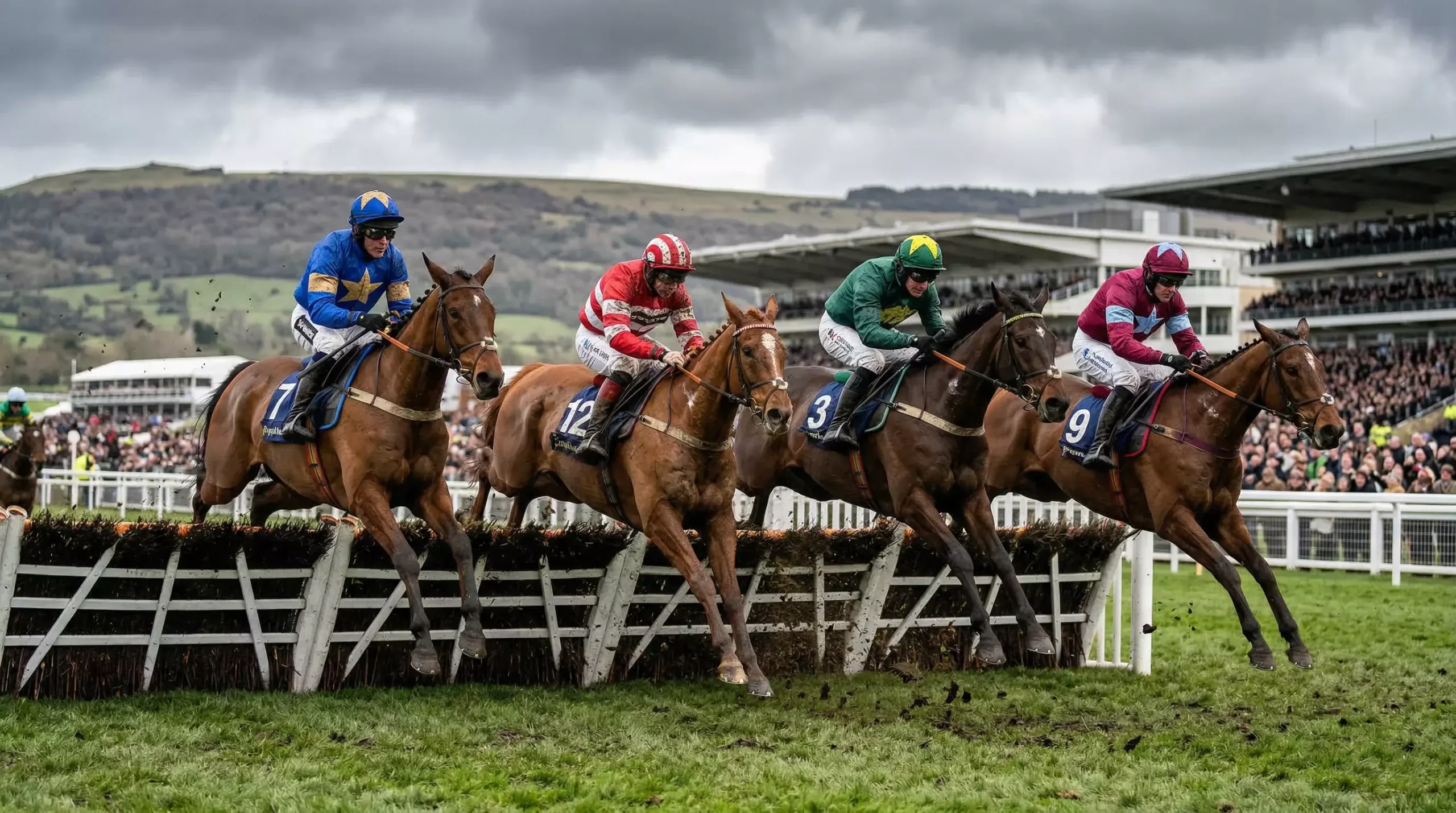
The Cheltenham Festival remains the most significant betting event in the National Hunt calendar, and 2026 is shaping up to be no exception. William Hill projected a betting turnover of approximately £450 million across the four days — a figure that reflects both the festival’s gravitational pull on punters and the depth of the ante-post markets that build for months before the first race. The ante-post landscape is already in motion, with trials season delivering results that confirm some favourites and expose others.
What follows is not a list of bankers. There are no certainties at Cheltenham — the terrain, the weather and the competition see to that. This is an assessment of where form meets value in the championship races, what the trials have told us, and how to approach the ante-post market with discipline rather than hope.
Headline Race Previews — Champion Hurdle, Gold Cup, Stayers’
The Champion Hurdle opens Tuesday’s card and sets the tone for the week. The two-mile championship is typically dominated by a small number of proven performers, and the market reflects that — the top two or three in the betting usually account for a combined implied probability that leaves little room for outsiders. The value in the Champion Hurdle tends to lie not in backing a rank outsider but in identifying which of the market principals has the strongest current form and the best Cheltenham profile. A horse that has won at the festival before carries a tangible advantage: the hill, the noise, the ground — these factors eliminate pretenders, and experience at Prestbury Park counts for more here than in almost any other race.
The Gold Cup on Friday is the week’s climax — three miles and two furlongs over fences, the ultimate test of stamina, jumping and class. The Gold Cup market is deeper than the Champion Hurdle’s, with six or seven realistic contenders in most years. Ante-post prices in the Gold Cup tend to offer more value because the uncertainty is genuine: fitness over the winter, the going on the day, and the gruelling demands of the race itself all create variables that the market cannot price precisely months in advance. Horses that have won a King George at Kempton or an Irish Gold Cup at Leopardstown carry the strongest trial credentials, but Cheltenham’s unique uphill finish has a habit of exposing weaknesses that flatter courses conceal.
The Stayers’ Hurdle over three miles on Thursday is the punter’s race — often the most open of the championship events, with form lines that intersect across long-distance hurdle races throughout the winter. The Stayers’ rewards thorough form analysis because the field is competitive, the favourite’s strike rate is lower than in the Champion Hurdle or Gold Cup, and the prices are consequently more generous. If you are looking for a championship race where homework pays, this is it.
Trial Form — What the Graded Races Have Told Us
The trials season runs from November to early March, and the graded races at Ascot, Cheltenham (in November and January), Leopardstown, Kempton and Haydock serve as the primary proving grounds. Each trial answers a specific question — and raises new ones.
The Christmas meetings are the first major checkpoint. Kempton’s King George VI Chase on Boxing Day is the Gold Cup’s most direct trial over three miles on a flat, right-handed track. A convincing King George winner enters the Gold Cup picture with momentum, though the track profiles are so different that the form does not always translate. Leopardstown’s Christmas meetings, particularly the Savills Chase and the Matheson Hurdle, tell a parallel story from the Irish perspective — and Irish-trained horses have dominated Cheltenham in recent years, making these results essential viewing for ante-post punters.
The January and February trials — Cheltenham’s own Trials Day, the Betfair Hurdle at Newbury, Haydock’s Peter Marsh Chase — narrow the field further. A horse that runs well at the Cheltenham Trials meeting has confirmed its ability to handle the track, the ground and the atmosphere. A horse that misses a trial, or runs below par, raises questions that the market will price in through a drift. The HBLB’s funding package of £77.1 million for 2026 ensures that these trial fixtures carry competitive prize money, attracting the best horses and producing the most informative form.
The discipline is to take the trial form at face value rather than to project what you hope a horse might do at the festival. A horse that has produced two mediocre trial runs does not become a Cheltenham contender because you remember what it did eighteen months ago. Current form — recent, relevant, honest — is the only form that matters at this stage of the season.
Market Movers and Ante-Post Value
Ante-post price movements at Cheltenham are driven by trial results, trainer quotes, injury bulletins and stable intelligence — some of it public, some of it whispered. A horse that wins a Grade 1 trial by ten lengths will shorten dramatically; one whose trainer reports a breathing issue will drift out of contention overnight. Tracking these movements is not just about timing your bet — it is about understanding what the market is telling you.
The most interesting market movers are the ones that shorten without an obvious public catalyst. A horse whose price contracts from 16/1 to 10/1 without winning a trial may be the subject of strong private work reports, a positive veterinary update or a stable that has quietly decided this is the target. These moves are not guarantees — stable confidence is sometimes misplaced — but they are information worth noting.
Value, in the Cheltenham ante-post context, is a function of trial form versus price. A horse that has won a Graded trial and sits at 8/1 may or may not represent value — it depends on how many other horses in the race have comparable form and what their prices are. A horse at 20/1 whose trial form is only slightly below the favourite’s may offer better expected value even though its outright chance is lower. The maths is the same as in any value-betting exercise: compare your probability estimate with the implied probability of the odds, and bet when the overlay is sufficient.
Practical Tips for Cheltenham 2026 Ante-Post Betting
Cheltenham ante-post betting rewards patience and selectivity. A handful of practical principles will serve you better than any list of specific selections that could be outdated by the time you read this.
First, bet what you can afford to lose entirely. Ante-post bets carry non-runner risk, and at a festival where the ground can change overnight and connections frequently reroute horses to alternative targets, non-runners are not an anomaly — they are a structural feature. Stake accordingly: small, deliberate amounts that will not damage your bankroll if the horse never makes it to the start.
Second, spread your bets across the week. The festival has 28 races across four days. Concentrating your entire ante-post budget on the Gold Cup is a single-point-of-failure approach. Spreading it across four or five races — two championship events and two or three handicaps — diversifies your risk and increases the probability that at least one selection delivers.
Third, use Non-Runner No Bet (NRNB) selectively. On championship races where the leading contenders are likely to run, standard ante-post prices may offer better value than NRNB equivalents. On handicaps where entries are uncertain, NRNB provides insurance worth paying for.
Finally, do not confuse ante-post punting with ante-post gambling. The distinction is between a reasoned position based on trial form, market analysis and probability — and a speculative flutter based on a name you recognise. Form meets value only when the analysis is honest and the price is right. Everything else is entertainment staked with real money.
