
 Available in US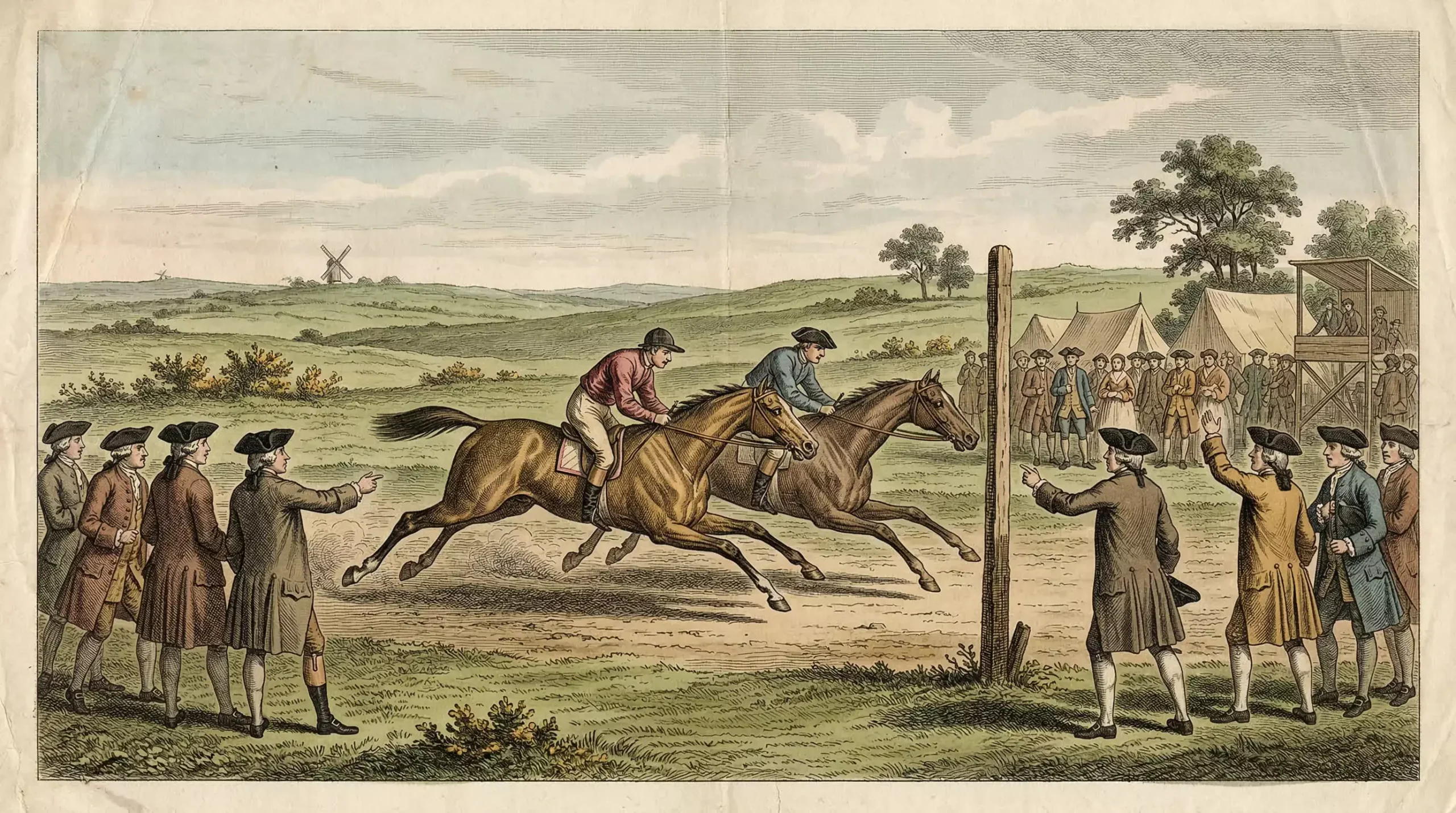
The British have been betting on horses for the better part of four centuries — long enough for the practice to evolve from informal wagers between aristocrats to a regulated, digitised industry generating £16.8 billion in gross gambling yield. That journey is not a dry timeline. It is a story of innovation, scandal, legislation and reinvention, and the betting landscape you use today — online accounts, live streaming, exchange trading — is the product of centuries in the making. Understanding where it all came from puts the modern market in context and, at the very least, gives you something to talk about at the racecourse bar.
Match Races and Coffeehouses — the 17th–18th Century
Horse racing in Britain predates the formal betting industry by a comfortable margin. Races between two horses — match races — were a feature of aristocratic life from at least the early 1600s, with wagers agreed between owners, spectators and anyone with enough confidence and coin to risk. The bets were personal, private and entirely unregulated. If your opponent refused to pay, your recourse was social pressure, a duel or nothing at all.
The coffeehouse culture of the late 17th and early 18th centuries gave betting a public venue. Establishments near Newmarket — where racing was already the dominant pastime — became informal exchanges where gentlemen posted odds, accepted wagers and settled debts. The most famous of these was Richard Tattersall’s establishment, which by the late 1700s had become the unofficial headquarters of racing’s betting community. Tattersall’s Rules, which governed the settlement of bets, persisted in various forms for over two centuries.
The emergence of the thoroughbred breed in the 18th century — founded on three imported Arabian stallions, the Byerly Turk, the Darley Arabian and the Godolphin Arabian — professionalised racing and, with it, betting. The first volumes of the Racing Calendar, published in the 1770s, gave punters a formal record of results and form. The first bookmakers as we would recognise them — individuals offering fixed odds against multiple outcomes in a race — appeared in the early 1800s, most notably at the old Newmarket course and at Epsom for the Derby.
By the mid-19th century, betting on horse racing was a mass-market activity. Bookmakers operated at every racecourse, off-course betting was conducted through runners and street bookies, and the industry was thriving in the most disorderly way imaginable. Fraud, welching (failing to pay winning bets) and manipulation were rampant. The sport needed governance, and it was about to get it.
From the Jockey Club to the Betting Levy Act 1961
The Jockey Club, established in the 1750s, was the first serious attempt to impose order on British racing. It set the rules for races, licensed courses and — crucially — controlled the Calendar, which gave it authority over the sport’s official record. The Club’s influence over betting was indirect: by regulating the sport itself, it created a framework within which betting could operate with some degree of trust.
Off-course betting remained a grey area for much of the 19th and early 20th centuries. The Street Betting Act of 1906 made it illegal to accept or place bets in public places, driving the activity underground rather than eliminating it. Street bookies operated in every working-class neighbourhood, tolerated by police and patronised by millions. The system was farcical — a vast illegal industry operating in plain sight — and successive governments struggled to reconcile the reality with the law.
The breakthrough came with the Betting and Gaming Act 1960, which legalised off-course betting shops from 1 May 1961. For the first time, ordinary punters could walk into a licensed premises and place a legal bet on a horse race without being at the track. The impact was immediate and transformative: thousands of betting shops opened within months, and the modern high-street bookmaker was born.
The same year, the Betting Levy Act 1961 established the Horserace Betting Levy Board, creating a mechanism for bookmakers to contribute a percentage of their profits back into the sport. The Levy — now set at 10% of gross profits from British racing — was a recognition that betting and racing were economically interdependent, and that one could not thrive without funding the other. It remains the financial backbone of British racing to this day.
Deregulation, Online Betting and the Exchange Revolution
The Gambling Act 2005 — implemented in 2007 — was the most significant regulatory overhaul in a generation. It replaced a patchwork of legislation with a single framework, created the Gambling Commission as the industry regulator, and liberalised advertising rules that had previously restricted how bookmakers could promote their services. The Act also established the legal basis for online gambling, which was already growing rapidly by the time the legislation took effect.
Online betting had begun in the late 1990s, with operators like Betfair launching what would become the most significant structural innovation in betting history: the exchange. Betfair, founded in 2000, allowed punters to back and lay horses against each other, with the exchange taking a commission on winners. It eliminated the traditional bookmaker model for those willing to learn the mechanics, and it introduced concepts — trading, in-play markets, lay betting — that had no precedent in racing’s long history.
The abolition of punter-facing betting tax in 2001 was another watershed. By removing the 9% duty that had been charged on stakes or winnings, the government eliminated the tax incentive for bettors to use offshore operators and brought the industry back onshore. The cost was borne by the operators through General Betting Duty on gross profits — a model that persists, in modified form, today.
Mobile betting accelerated the transformation. The smartphone revolution of the 2010s turned every pocket into a betting shop, and by the 2020s, the overwhelming majority of horse racing bets were placed digitally. The integration of live streaming, in-play betting, cash-out features and push notifications created a product that bore almost no resemblance to the betting-shop experience of 1961 — though the fundamental act remained the same: picking a horse and staking money on it.
2020s — Data, Tax Reform and What Comes Next
The 2020s have brought a new set of pressures. The Gambling Act 2005 is widely considered outdated, and the government’s White Paper on gambling reform — published in 2023 — signalled a period of regulatory tightening that is still playing out. Affordability checks, stake limits on online products, advertising restrictions and enhanced player protection measures are all on the table or already in effect.
The Autumn Budget 2025 restructured gambling duties, raising Remote Gaming Duty to 40% while preserving the racing-specific rate at 15%. The BHA responded by acknowledging that racing had been spared the worst of the increases, with an official statement welcoming the government’s decision to spare the industry from punishing tax increases — noting that racing supports 85,000 livelihoods and delivers £4 billion in economic impact. But the broader trajectory is clear: the regulatory environment is tightening, and the industry’s relationship with government is being renegotiated in real time.
UK gross gambling yield stands at £16.8 billion in FY 2024-25 — a figure that represents the cumulative product of four centuries of evolution from coffeehouse wagers to algorithmic exchanges. Horse racing remains the second-largest betting sport after football, and the Levy continues to channel bookmaker profits back into prize money, integrity and welfare. The history of horse racing betting in Britain is not finished. It is still being written, one regulatory reform and one technological innovation at a time, by the same forces that have shaped it since the first match races at Newmarket: money, competition and an enduring human fascination with picking the winner.
