
 Available in US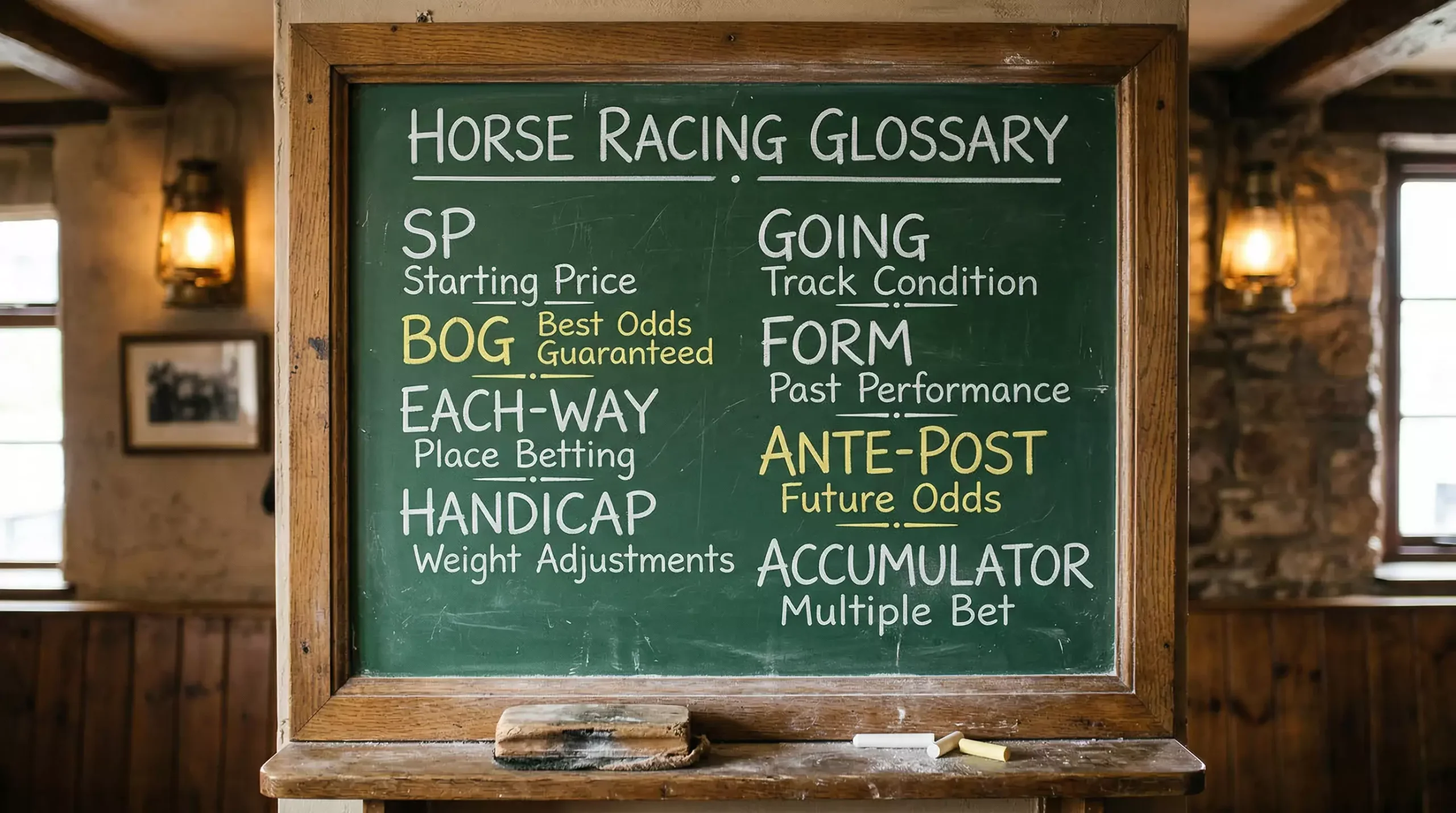
Horse racing has its own language — a shorthand developed over centuries that compresses complex ideas into a word or two. If you have ever stared at a racecard and wondered what “CD” means, why a horse is described as “wearing cheekpieces for the first time,” or what exactly the bookmaker means by “BOG,” this glossary is for you. Every term is defined in plain English, grouped by category, and written for bettors rather than insiders. Bookmark it, refer back to it, and treat it as a living reference that grows with your understanding of the sport.
Betting Terms (A–Z)
Accumulator (Acca): A single bet linking four or more selections. All must win for the bet to pay out. Returns compound with each leg.
Ante-Post: A bet placed well before race day, often weeks or months in advance. Typically offers better odds but carries non-runner risk — no refund if the horse does not run.
Best Odds Guaranteed (BOG): A promotion where the bookmaker pays you the higher of your fixed price or the Starting Price. Available at most major operators on UK and Irish racing.
Cash Out: A feature that lets you settle a bet before the event finishes, locking in a profit or cutting a loss. The cash-out value is set by the bookmaker and includes a margin.
Double: An accumulator with two selections. Both must win.
Each-Way (E/W): Two bets in one — a win stake and a place stake. If the horse wins, both pay. If it places, only the place part pays at a fraction of the win odds.
Fixed Odds: Odds that are locked in when you place your bet. Your return is known in advance, regardless of how the market moves afterwards.
Forecast: A bet predicting the first and second in the exact order. A reverse forecast covers both permutations.
Free Bet: A promotional token credited by the bookmaker. If the bet wins, you receive the profit but not the stake.
Levy: The Horserace Betting Levy — a 10% charge on bookmakers’ gross profits from British racing, collected by the HBLB. It funds prize money, integrity services and veterinary science. The Levy hit a record £109 million in FY 2024-25.
Lucky 15: A system bet covering four selections with 15 bets: four singles, six doubles, four trebles and one four-fold.
Nap: A tipster’s best bet of the day. From the card game Napoleon.
Non-Runner No Bet (NRNB): A condition on selected ante-post markets where your stake is refunded if the horse does not run.
Odds-On: Odds shorter than even money (e.g., 4/6, 1/2). You stake more than you stand to win in profit.
Overround: The bookmaker’s built-in margin. The sum of implied probabilities across all runners in a race exceeds 100%, and the excess is the overround.
Patent: Seven bets on three selections: three singles, three doubles and one treble.
Rule 4: A deduction applied to winning bets when a horse is withdrawn after the market has been formed. The deduction compensates for the shortened field.
SP (Starting Price): The official odds at the moment the race starts, determined by on-course bookmakers.
Treble: An accumulator with three selections.
Tricast: A bet predicting the first three finishers in exact order.
Trixie: Four bets on three selections: three doubles and one treble. Two winners guarantee a return.
Racing and Track Terms (A–Z)
All-Weather (AW): Racing on artificial surfaces — Polytrack, Tapeta or Fibresand — at venues like Wolverhampton, Chelmsford, Kempton, Lingfield and Newcastle. Runs year-round and is unaffected by rain.
Bumper: A National Hunt flat race — no hurdles or fences. Used to introduce young jump horses to the racecourse experience.
Chase: A steeplechase — a National Hunt race over fences, which are larger and more solid than hurdles.
Classic: One of the five historic Flat races: the 2,000 Guineas, 1,000 Guineas, Oaks, Derby and St Leger. Restricted to three-year-olds.
Declarations: The formal confirmation that a horse will run in a race. Final declarations are typically made 24 to 48 hours before the race.
Flat: Racing on level ground without obstacles. The turf season runs April to November; all-weather racing fills the gaps.
Furlong: One-eighth of a mile (approximately 201 metres). The standard unit of distance in British racing.
Going: The condition of the ground. The scale runs from Hard through Firm, Good to Firm, Good, Good to Soft, Soft, to Heavy on turf. All-weather surfaces use a separate scale.
Group Race: The highest-quality Flat races, graded Group 1, 2 or 3 in descending order of prestige. Group 1 is the pinnacle.
Handicap: A race where the official handicapper assigns weights to level the field. Better-rated horses carry more weight.
Hurdle: A National Hunt race over smaller, brush-topped obstacles. Generally considered a stepping stone to chasing.
Listed: A quality level below Group 3 but above standard conditions races. Often a proving ground for horses on the way up.
National Hunt (NH): Jump racing — racing over hurdles or fences. The core season runs October to April, peaking at Cheltenham and Aintree.
Novice: A horse that has not won in the relevant category before the current season. Novice hurdles and novice chases are the entry-level jump races.
Raceday: An organised meeting at a licensed racecourse. UK racecourses attracted 5.031 million attendees in the most recent BHA figures — a 4.8% year-on-year rise.
Stewards: Officials responsible for enforcing the rules of racing at a meeting. They can demote, disqualify or suspend horses, jockeys and trainers.
Tote: The pool betting operator in UK racing. All stakes go into a shared pot, and dividends are paid to winning tickets after a deduction.
Weighing Room: The area at the racecourse where jockeys weigh in and out before and after each race. Weight verification is a legal requirement.
Form and Racecard Terms (A–Z)
BF (Beaten Favourite): A racecard notation indicating the horse was favourite last time out and lost.
Blinkers: Equipment that restricts a horse’s peripheral vision, used to help it concentrate. First-time blinkers are a significant racecard signal.
CD (Course and Distance): A racecard marker showing the horse has won at this course over this distance before. One of the most reliable positive indicators.
Cheekpieces: Similar to blinkers but less restrictive, covering the sides of the horse’s face. Often tried when blinkers are considered too extreme.
Claiming Race: A race where every horse is available to “claim” (buy) at a set price. Trainers use claimers to place horses in competitive fields and sometimes to sell.
Dam: The mother of a horse. The dam’s racing record and her other offspring provide breeding clues about stamina and ability.
Draw: The starting stall position in a Flat race. On certain courses, specific draw positions confer a statistical advantage.
Drift: When a horse’s odds lengthen (increase) — less money is coming in for it relative to the rest of the field.
Form Figures: The string of numbers and letters on a racecard summarising recent results. Read left to right, most recent run on the far right. Key: 1 = won, 2 = second, 0 = tenth or worse, P = pulled up, F = fell, U = unseated rider.
Gelding: A castrated male horse. Geldings cannot run in the Classics but are the backbone of National Hunt racing.
Hood: A head covering that obscures a horse’s view at the start, removed as the stalls open. Used to calm anxious horses in the pre-race routine.
Maiden: A horse that has not yet won a race. Maiden races are restricted to horses seeking their first victory.
Official Rating (OR): The BHA handicapper’s assessment of a horse’s ability, expressed as a number. Higher numbers indicate better horses. Used to allocate weight in handicaps.
Pulled Up (P): A horse that was stopped by the jockey before completing the race. In jump racing, this often indicates the horse was struggling or injured.
Sire: The father of a horse. The sire’s influence on stamina, speed and going preference is a key breeding factor.
Tongue Tie: A strap that holds a horse’s tongue in place to prevent it from obstructing the airway during a race. A first-time tongue tie is a significant equipment change.
Visor: A variation of blinkers with a small slit allowing partial peripheral vision. A compromise between full blinkers and cheekpieces.
Weight: The total weight a horse carries in a race, including the jockey and equipment. Listed in stones and pounds on UK racecards.
