
 Available in US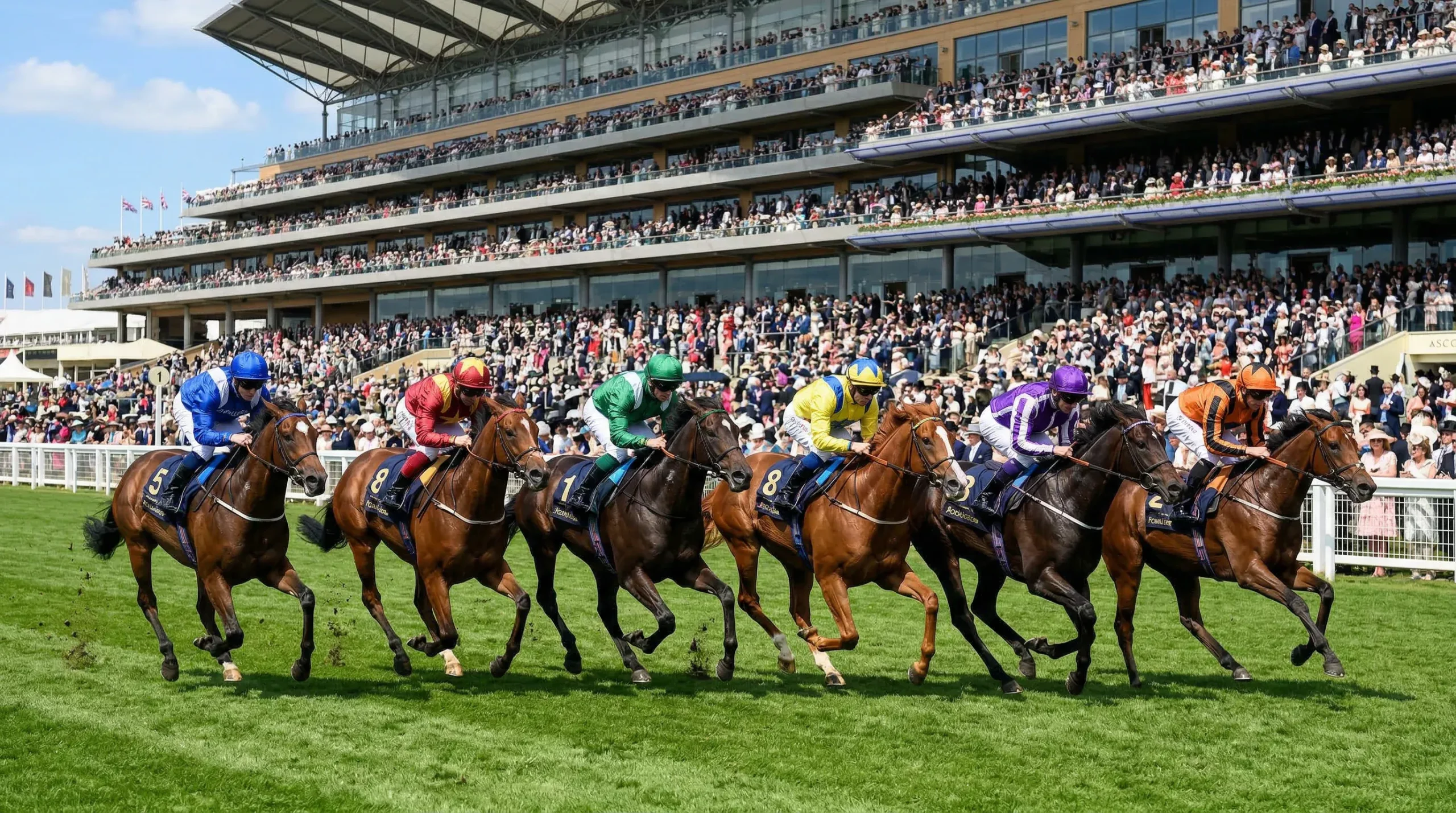
Royal Ascot is the Flat’s showpiece — five days in June that bring together the best racehorses in Europe, the most competitive fields of the turf season, and a betting turnover that rivals any meeting in the calendar. It is part sporting event, part social occasion, and entirely unmissable for anyone who takes Flat racing seriously. From the Queen Anne Stakes on Tuesday through to the Diamond Jubilee on Saturday, the card is packed with Group 1 contests, heritage handicaps and the kind of large-field cavalry charges that make each-way betting irresistible.
For bettors, Royal Ascot demands preparation. The fields are strong, the form is international, and the market moves fast. Understanding the festival’s structure, the key races, and the form factors that matter most at this unique venue is the difference between punting with confidence and punting with hope.
The Royal Ascot Week — Schedule and Feature Races
Royal Ascot runs from Tuesday to Saturday in the third week of June, with seven or eight races each day and a total of approximately 35 races across the meeting. The quality is consistently elite: eight Group 1 races are spread across the five days, supported by Group 2 and Group 3 events and a selection of handicaps that attract huge fields and massive betting interest.
Tuesday opens with the Queen Anne Stakes, a Group 1 mile contest that sets the tone for the week. The Coventry Stakes on the same day is the first major two-year-old race of the season, often featuring horses who will contest the following year’s Classics. Wednesday features the Prince of Wales’s Stakes — a Group 1 over ten furlongs that regularly attracts proven middle-distance horses from across Europe — alongside the Royal Hunt Cup, a mile handicap that can have 30 runners and is one of the week’s great betting puzzles.
Thursday is traditionally Gold Cup day. The Gold Cup itself, run over two and a half miles, is the ultimate test of stamina on the Flat and carries as much prestige as any race in the calendar. Friday’s highlight is the Coronation Stakes, a Group 1 for three-year-old fillies, while Saturday builds to the Diamond Jubilee Stakes, a Group 1 sprint that brings the meeting to a close with a six-furlong contest featuring the fastest horses in training.
The meeting’s scale is reflected in prize money. The BHA’s 2025 Racing Report recorded record total prize money of £194.7 million across UK racing, and Royal Ascot accounts for a significant share of that figure, with individual Group 1 purses exceeding £500,000 and the Gold Cup pushing towards seven figures. The money attracts the best horses, which attracts the deepest betting markets, which is precisely why the meeting matters so much to punters.
Key Betting Markets — Ante-Post and Day-of-Race
Royal Ascot ante-post markets open months in advance, and the early prices on the feature races can offer substantial value for punters willing to accept the non-runner risk. The Gold Cup, Prince of Wales’s Stakes and Diamond Jubilee are typically priced up by February, with markets deepening as trial races in May and early June clarify the likely contenders.
The ante-post market for the handicaps is trickier. Entries for the Royal Hunt Cup, the Wokingham Stakes and the other big-field handicaps are not confirmed until closer to the meeting, and weights are published only a few weeks before the race. Backing a horse in a handicap ante-post requires confidence not just in its ability but in its likely rating, its weight, and whether it will be balloted out if the race is oversubscribed. For most punters, day-of-race betting on the handicaps is the safer route.
On race day, the markets move quickly. The sheer volume of money flowing into Royal Ascot markets means that prices can shift significantly between the morning and the off. Best Odds Guaranteed is essential during the festival — a horse you back at 10/1 in the morning that drifts to 14/1 by the off represents a free upgrade that BOG delivers automatically. Taking prices early and trusting BOG to capture any drift is the optimal strategy for most Ascot bettors.
Each-way betting dominates the handicap races. Fields of 20 to 30 runners with four or five places at 1/4 or 1/5 odds create the conditions where each-way thrives. The Group 1 races, by contrast, attract smaller fields — typically eight to twelve runners — and are better suited to win-only or straight forecast bets where you have a strong opinion about the likely finishing order.
Form Factors Unique to Flat Racing at Ascot
Ascot is not a straightforward track, and the form factors that matter here are specific to its geography. The course is right-handed, galloping, with a stiff uphill finish that tests stamina even over sprint distances. A horse that quickens brilliantly on a flat track may struggle to maintain its speed on the Ascot rise. Conversely, a strong galloper that relishes an honest pace will often outperform its form from flatter venues.
The straight course — used for races up to a mile — runs uphill from the start, with a dip in the middle before rising again to the finish. The draw can be influential, though the bias shifts depending on the going and the rail position. In soft ground, horses drawn high (towards the stands’ rail) sometimes have an advantage; in firmer conditions, the bias is less pronounced. Monitoring the draw data from the first day’s racing gives you live intelligence for the rest of the week.
The round course — used for races over a mile and a quarter or further — sweeps right-handed with a turn into the home straight that rewards horses with good balance and a strong finishing kick. The Gold Cup distance of two miles and four furlongs demands genuine stamina, and the form of horses from shorter-distance races does not always translate.
BHA data for 2025 records average field sizes of 11.02 at Premier Flat fixtures, and Royal Ascot consistently delivers fields at or above that number. In the big handicaps, you might assess 25 or more runners, each with its own going preference, draw position, jockey booking and recent form. The analytical challenge is substantial, but it is also the reason why value exists — in a field of 25, the market cannot price every horse accurately, and the bettor who does the deepest homework has the best chance of finding a mispriced runner.
Where to Find the Best Royal Ascot Odds
Royal Ascot is the week when every major bookmaker sharpens its pricing to attract the peak-season betting audience. Competition for punter money is fierce, and that competition benefits you. Odds comparison sites show the best available price across a dozen or more bookmakers, and the differences on an Ascot Group 1 can be meaningful — a horse at 7/1 with one operator and 8/1 with another represents a 14% improvement in your return.
Enhanced place terms are another competitive weapon during the festival. Bookmakers routinely extend each-way places from four to five, six or even seven on selected handicaps. The extra places lower the risk of an each-way bet, though the fraction may drop from 1/4 to 1/5 — always check the terms, not just the number of places.
Exchanges offer an alternative pricing route on the Group 1 races, where liquidity is deep enough to support significant stakes. The back price on Betfair for a Queen Anne Stakes runner will often exceed the best bookmaker price by one or two ticks, with the only cost being commission on winning bets. For punters who are comfortable with exchange mechanics, Royal Ascot is one of the best weeks of the year for exchange betting because the liquidity matches the demand.
The Flat’s showpiece rewards preparation, patience and price discipline. Back your selections at the best available odds, use BOG where it applies, and treat the handicaps and Group 1s as separate challenges that demand different bet types. The five days will test your stamina almost as much as the Gold Cup tests the horses — but the returns for a well-researched, well-staked Royal Ascot are among the most satisfying in the racing year.
