
 Available in US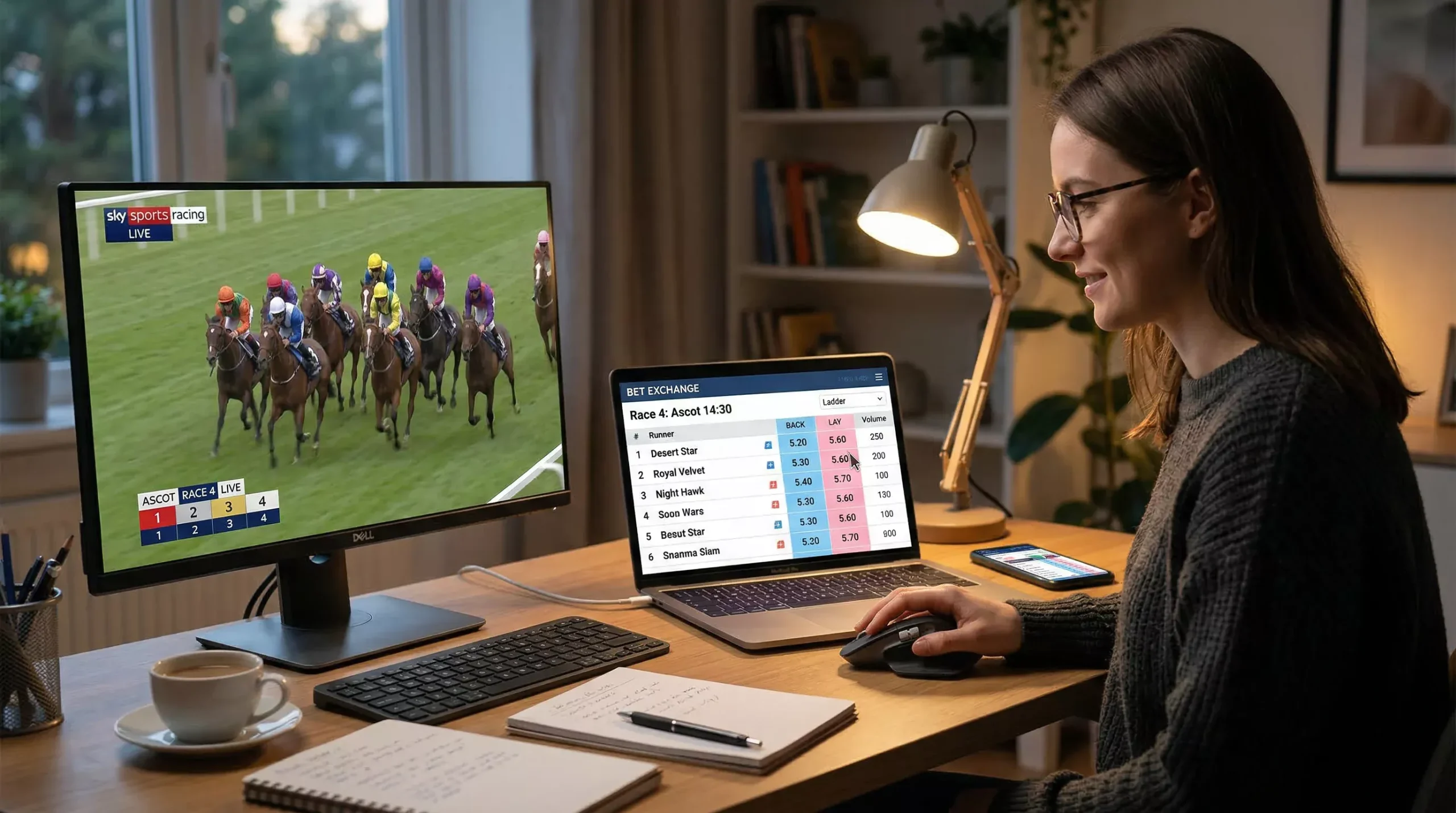
A betting exchange removes the bookmaker from the equation. Instead of betting against a company that sets the odds and takes a margin, you bet against other punters. One person backs a horse to win; another lays that horse — effectively betting it will lose. The exchange matches the two sides and takes a small commission on the winner’s profit. It is peer-to-peer betting in its purest form, and within the UK horse racing market — which generates £766.7 million in remote gross gambling yield — exchanges have carved out a distinct and growing niche.
For punters willing to learn the mechanics, exchanges offer advantages that traditional bookmakers cannot match: better odds on many markets, the ability to lay horses as well as back them, and the option to trade positions during a race. The learning curve is real, but it is not steep, and the payoff for understanding how exchanges work is a structural edge in how you approach horse racing betting.
The Exchange Model — Backing, Laying and the Order Book
Backing on an exchange is conceptually identical to placing a bet with a bookmaker. You back a horse at a given price, and if it wins, you collect your profit. The difference is that the price is set not by a bookmaker’s trading team but by the market — by other users offering to lay that horse at a specific price. When a backer and a layer agree on a price and a stake, the bet is matched.
Laying is the opposite: you are betting that a horse will not win. When you lay a horse at 5.0 (4/1 in fractional terms), you are offering to pay out at those odds if the horse wins, in return for keeping the backer’s stake if it loses. Your liability — the maximum you can lose — is the backer’s stake multiplied by the odds minus one. On a £10 lay at 5.0, your liability is £10 × (5.0 – 1) = £40. If the horse loses, you win £10. If it wins, you pay £40. Laying is the unique feature that separates exchanges from traditional bookmakers, and it opens an entirely different approach to racing.
The order book is the mechanism that makes it work. On an exchange screen, you see two columns: the back price (what backers are willing to pay) and the lay price (what layers are willing to offer). The best available back price is the highest price a layer is offering, and the best available lay price is the lowest price a backer is requesting. The gap between the two — the spread — is the exchange equivalent of the bookmaker’s overround. On liquid markets, the spread is narrow; on thin markets, it can be wide.
If you want a price that is not currently available, you can request it. Place an unmatched back order at 6.0 when the current best back price is 5.5, and your order sits in the book until either someone matches it or you cancel. This patience-based approach — waiting for the market to come to you — is a core skill of exchange betting and has no equivalent in the fixed-odds world, where you either take the price on screen or walk away.
Commission Rates and Liquidity — What to Watch
Exchanges make money through commission, not margin. When you win a bet, the exchange takes a percentage of your net profit — typically between 2% and 5%, depending on the platform and your activity level. Betfair Exchange, the dominant player in the UK, charges a standard commission of 5% on net winnings, though high-volume users can negotiate lower rates. Smarkets charges 2%, positioning itself as the low-cost alternative.
Commission changes the effective odds. If you back a horse at 6.0 (5/1) and it wins, your gross profit on a £10 bet is £50. At 5% commission, Betfair takes £2.50, leaving you with £47.50 net profit. At 2% on Smarkets, the commission is £1.00 and your net profit is £49.00. Over hundreds of bets, the difference between 2% and 5% commission is material — it is the exchange equivalent of shopping for the best odds among bookmakers.
Liquidity is the other critical variable. Liquidity refers to the amount of money available in the market — how much is waiting to be matched on the back and lay sides. On a Premier fixture at Cheltenham or Ascot, liquidity is deep: thousands of pounds are available at each price point, and your bets are matched instantly. On a Tuesday evening at Wolverhampton, liquidity may be thin, and you might struggle to get more than a few pounds matched at the price you want.
Low liquidity means wider spreads, slower matching and smaller maximum stakes. For punters used to placing £50 or £100 bets with a bookmaker, the exchange may only be able to absorb that kind of money on major races. On minor fixtures, you may need to scale down or accept a less favourable price to get matched. Checking the available liquidity before committing is a habit that exchange users develop quickly.
Exchange vs Traditional Bookmaker — Pros and Cons
The structural advantages of exchanges are clear. Prices are generally better because there is no bookmaker margin built in — the market is set by supply and demand, and the only cost is commission on winning bets. On liquid markets, the back price on an exchange regularly exceeds the best bookmaker price by one or two points. Over a season, that difference translates into significantly higher returns for the same strike rate.
The ability to lay is the other major advantage. If you believe a heavily backed favourite is vulnerable, you can lay it at short odds — a strategy that is impossible with a traditional bookmaker unless you use a separate lay-to-back arbitrage setup. Laying also enables hedging: if you have backed a horse ante-post and its price has shortened, you can lay it on the exchange to lock in a guaranteed profit regardless of the result.
The disadvantages are equally real. Exchanges do not offer Best Odds Guaranteed, free bets or welcome bonuses. The promotional ecosystem that traditional bookmakers use to attract and retain customers does not exist on an exchange. There is no price boost, no accumulator insurance, no enhanced place terms. What you see is what you get — a raw market with low margins and no frills.
Account restrictions are also handled differently. Traditional bookmakers routinely restrict or close accounts of winning punters — a practice that frustrates serious bettors. Exchanges, by contrast, have no incentive to restrict winners because they profit from commission on both sides. A punter who consistently wins on Betfair is a valuable customer, not a problem to be managed. BHA data shows total UK racing turnover declined 4.3% in 2025, and part of that shift may reflect punters migrating from bookmakers with restrictive account policies to exchanges where winning is not penalised.
Trading a Race — Entry-Level Strategies
Trading a race means backing a horse at one price and then laying it at a shorter price — or laying first and backing later at a longer price — to lock in a profit or minimise a loss before the result is known. It is closer to financial trading than traditional betting, and it is one of the exchange’s most distinctive capabilities.
The simplest trade works like this: you back a horse at 8.0 for £10. Its price shortens to 5.0 as race time approaches — perhaps a positive trainer quote appeared, or the going was changed in the horse’s favour. You lay the horse at 5.0 for £16, which balances the book and locks in a guaranteed profit regardless of whether the horse wins. If it wins, you collect on the back bet and pay out on the lay; if it loses, the reverse applies. Either way, you end up with a net profit calculated from the price movement.
This requires two things: a market that moves, and the discipline to close the position when the profit target is reached rather than holding out for more. Greed is the most common cause of trading losses — a punter who has a profitable position but waits for the price to move further, only to see it swing back against them. Setting a target profit before the trade begins and executing the exit when it is reached is the foundational discipline of exchange trading.
In-play trading — backing and laying during the race — is the advanced version. Prices move violently once the race begins, reacting to position, pace and the jockey’s actions. The speed required to trade in-play is beyond most casual punters, but for those who develop the skill, the profit potential is significant. Peer-to-peer betting at its most dynamic, where the market moves in real time and the edge goes to the fastest, most informed participant.
