
 Available in US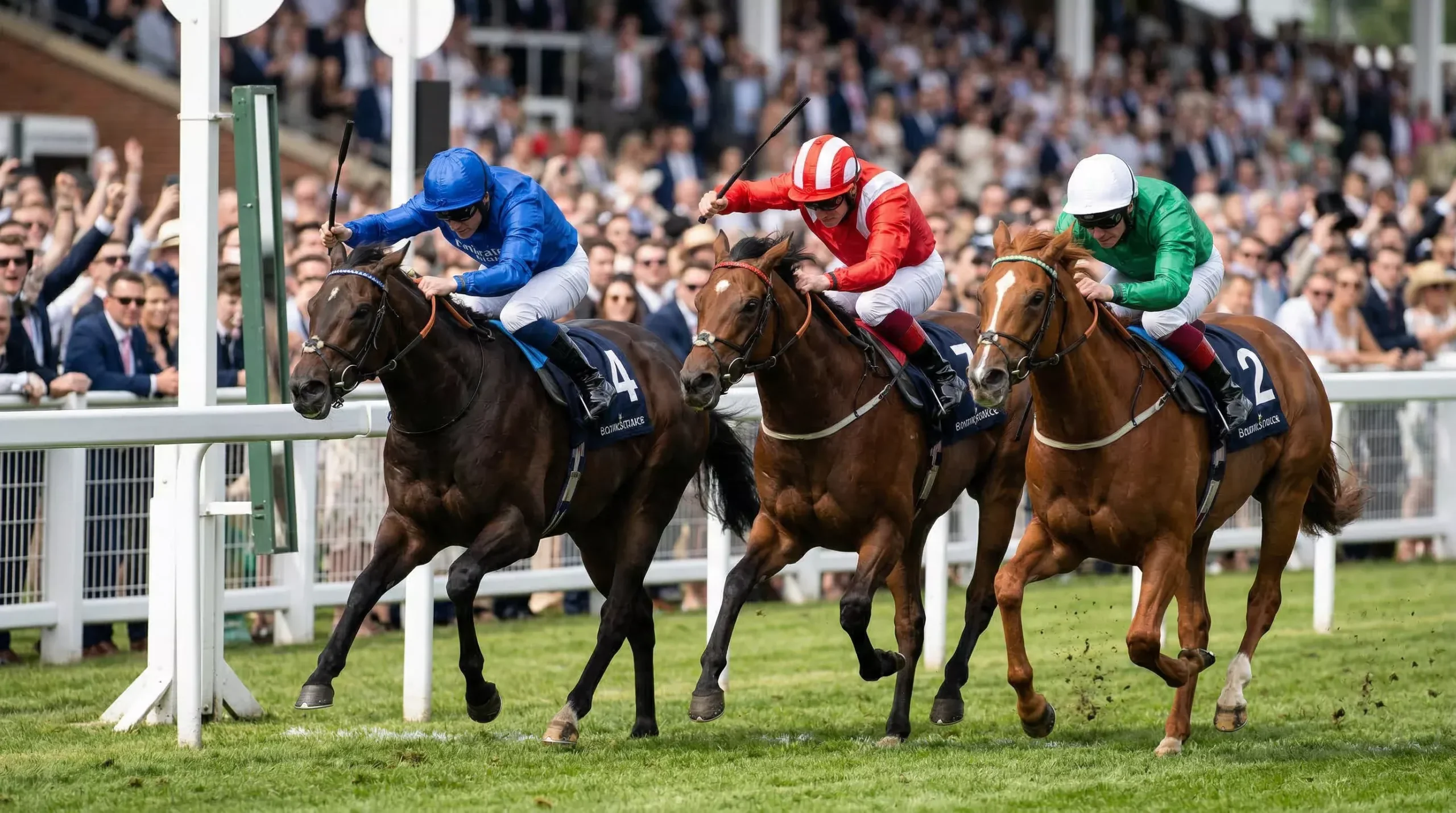
Most horse racing bets ask you to pick a winner. Forecasts and tricasts ask you to do something harder — predict the exact finishing order. Name the first and second in a forecast, or the first three home in a tricast, and the returns can dwarf anything a simple win bet produces. The difficulty is proportionate: exact-order betting demands a deeper level of analysis, a willingness to accept low strike rates, and the discipline to stake appropriately for a bet type where losing is the default outcome.
Despite the challenge, forecasts and tricasts occupy a genuine niche in the punter’s toolkit. They reward race-reading skills that go beyond identifying the likely winner — understanding pace, assessing how a race will unfold, and judging which horses are likely to fill the places even if they cannot win. For punters who enjoy that level of engagement, exact-order betting is where the sport’s analytical depth meets its most generous payouts.
How a Forecast Bet Works — Straight and Reversed
A forecast bet requires you to name the first two finishers in the correct order. If you predict Horse A to win and Horse B to finish second, that is a straight forecast — a single bet covering one specific outcome. If Horse A wins and Horse B is second, you collect. Any other finishing order and the bet loses.
A reverse forecast covers both permutations: A first and B second, or B first and A second. This doubles your stake because it is effectively two straight forecasts, but it removes the pressure of predicting the exact order between your two selections. You are still saying “these two horses will fill the first two places” — you just do not need to specify which finishes where.
A combination forecast extends the principle to three or more selections. If you fancy three horses — A, B and C — a combination forecast covers every possible pairing: A-B, A-C, B-A, B-C, C-A, C-B. That is six bets, and your total stake is six times the unit. The advantage is coverage; the disadvantage is cost. With four selections, the combination becomes twelve bets; with five, it is twenty. The numbers escalate quickly.
Field size shapes the difficulty and the potential return. The BHA’s 2025 Racing Report records average field sizes of 8.90 runners in Flat races and 7.84 over jumps, rising to 11.02 and 9.41 at Premier fixtures. In a 12-runner race, the number of possible forecast outcomes is 12 × 11 = 132. A straight forecast covers one of those 132 possibilities. The odds reflect that improbability, which is why forecast dividends can be spectacularly large when two outsiders fill the first two places.
Tricast Bets — Predicting the First Three Home
A tricast takes the forecast concept one step further: you must name the first, second and third in the exact order. In a 12-runner race, the number of possible tricast outcomes is 12 × 11 × 10 = 1,320. A straight tricast covers one. The potential returns are enormous, but the probability of success is correspondingly small.
Like forecasts, tricasts come in straight and combination variants. A straight tricast is a single bet: Horse A first, Horse B second, Horse C third, in that precise order. A combination tricast covers all possible orderings of your three selections across the first three places — that is six bets (3 × 2 × 1 = 6). A combination tricast with four selections becomes 24 bets (4 × 3 × 2), and cost control becomes a genuine concern.
Tricasts are only available in races with a minimum number of runners — typically eight or more for a full tricast, though this varies by bookmaker. On smaller fields, the reduced number of possible outcomes means the returns would not justify offering the bet type.
The satisfaction of landing a tricast is considerable — there is a reason punters return to the format despite long losing runs. But the strike rate is harsh. A punter who places ten tricasts per week and hits one every three months is performing respectably. Staking should reflect this reality: small, consistent stakes that you can afford to lose ten, twenty or thirty times before the next collect. The return when it arrives should more than compensate for the accumulated losses, provided you are selecting with discipline rather than guesswork.
CSF Dividends vs Fixed-Odds Forecasts
Forecast returns can be calculated in two ways, and the distinction matters. A Computer Straight Forecast (CSF) is the industry-standard payout method used by most UK bookmakers. The dividend is calculated after the race by an algorithm based on the Starting Prices of the first two finishers. You do not know the return when you place the bet — like a Tote dividend, it is declared post-race.
CSF dividends vary enormously. When the first two home are both outsiders, the CSF can be hundreds of pounds to a £1 stake. When the favourite wins and the second favourite finishes second — the most predictable outcome — the CSF might be as low as £3 or £4. The algorithm accounts for the improbability of the result, so a forecast that “everyone saw coming” pays modestly, while a shock result pays handsomely.
Some bookmakers also offer fixed-odds forecasts, where the price is calculated from the individual odds of the two horses at the time you place the bet. The bookmaker multiplies the two prices together (with adjustments) and offers a fixed return. The advantage is certainty — you know the payout before the race. The disadvantage is that the bookmaker builds in a wider margin, and the fixed-odds forecast often pays less than the CSF would have done.
In practice, most UK punters use the CSF by default, because it is the standard settlement method and requires no additional action. Comparing the CSF dividend to the fixed-odds equivalent after the race is a useful exercise — it teaches you which scenarios produce CSF dividends that exceed fixed odds (typically when outsiders are involved) and which produce disappointing CSFs (typically when short-priced horses fill the places). Over time, this understanding helps you decide when to take a fixed-odds forecast and when to let the CSF algorithm do its work.
When Forecasts and Tricasts Offer Genuine Value
Forecasts and tricasts offer genuine value in specific race types — and poor value in others. Knowing the difference is crucial.
The ideal conditions are large-field handicaps where the form is closely matched. In a 16-runner handicap hurdle at Cheltenham, where multiple horses have a realistic chance, the forecast and tricast dividends tend to be generous because the number of possible outcomes is vast and the market has no single dominant favourite. During the 2024 Cheltenham Festival, Flutter platforms processed 34.9 million bets across four days, and exotic bets contributed meaningfully to that volume precisely because festival handicaps are the natural habitat for this bet type. As William Hill’s Head of Racing, Lee Phelps, has noted, the competitive clash between bookmakers and punters over four days of the Cheltenham Festival is unrivalled in jump racing — with around £450 million expected to be wagered across the 2026 event.
Conversely, small-field conditions races — a five-runner Group 1 with a dominant favourite — are poor forecast territory. The number of possible outcomes is small, the dividend is compressed, and the favourite’s presence drags down the CSF even when a less-expected horse fills the second slot.
Race-reading is the analytical skill that separates profitable forecast punters from hopeful ones. If you can predict not just which horse will win but how the race will unfold — which horse will lead, which will track the pace, which will finish fast from off the pace — you can identify likely first-second combinations that the raw odds do not fully reflect. It is the most intellectually demanding form of horse racing betting, and for those who enjoy the challenge, it is also the most rewarding.
