
 Available in US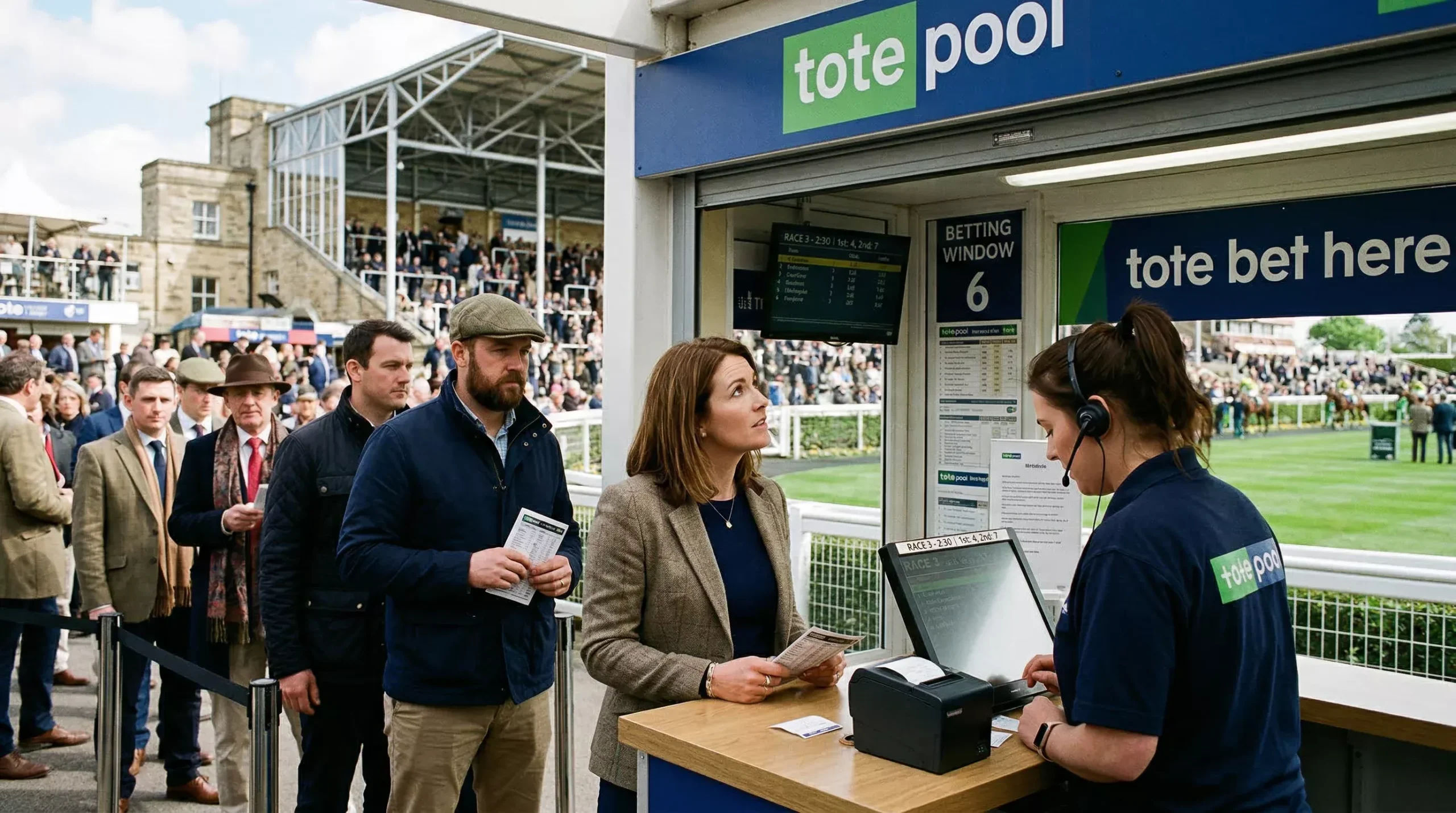
There are two fundamentally different ways to bet on the same horse in the same race — and most punters only ever use one. Fixed-odds betting with a bookmaker is the default: you see a price, you take it, and if the horse wins, you know exactly what you are getting back. Pool betting with the Tote works differently: your stake goes into a shared pot, and the payout depends on how much money is in the pool and how many other punters backed the same horse.
The question of pool versus price — which pays better — has no universal answer. It depends on the race, the field, the popularity of the winner, and the size of the pool. What can be said is that each system has structural advantages in specific situations, and understanding when to use one over the other is a genuine edge that most recreational bettors overlook entirely.
How Tote Pool Betting Works: Dividends vs Fixed Odds
The Tote — operated by UK Tote Group — runs a pari-mutuel system. All stakes on a given bet type (win, place, each-way, Placepot, etc.) go into a pool. After the operator takes a deduction — typically between 13% and 28% depending on the bet type — the remaining pool is divided among the winning tickets.
The payout is expressed as a dividend, declared after the race. A Tote win dividend might read “£4.20 to a £1 stake,” meaning a £1 bet returns £4.20 (including the stake). Unlike fixed odds, you do not know the return when you place the bet. The dividend is calculated only once the pool is closed, the race is run, and the operator has determined how many winning tickets share the pot.
The size of the pool determines the quality of the dividends. On a major Saturday meeting or at a festival — where racecourse attendance reached 5.031 million in the most recent BHA 2025 Racing Report figures, a 4.8% annual increase — the Tote pools are large and liquid. Large pools smooth out volatility and tend to produce dividends that reflect the true market — sometimes above and sometimes below the equivalent bookmaker SP.
On quieter cards — a Tuesday afternoon at a minor all-weather track — the pool may be small, and a handful of large bets can skew the dividends dramatically. A punter who backs the winner heavily in a thin pool drags down their own return, because the pool has fewer losing tickets to fund the payout. This is the Tote’s structural weakness at the lower end of the fixture calendar.
Fixed-Odds Bookmakers — Locked Price, Known Return
Fixed-odds betting is the model that dominates online horse racing in the UK. You see a price — 5/1, 8/1, 14/1 — and when you place your bet, that price is locked. If the horse wins, the bookmaker pays at the agreed odds regardless of what happens in the wider market. Your return is known at the moment you click “place bet.”
This certainty is the primary advantage. When you take 8/1 on a horse at 10am, you know that a £10 win bet returns £90. You can calculate your return, factor it into your bankroll planning, and make a rational decision about whether the price represents value. There is no ambiguity, no waiting for a dividend, and no risk that other punters’ behaviour will reduce your payout.
The bookmaker’s margin is embedded in the odds — the overround — and it is visible if you know how to calculate it. A typical UK horse race has an overround between 112% and 125%, meaning the bookmaker has built in a margin of 12% to 25% across the field. This is the cost of certainty: you are paying a premium for knowing your return in advance, and that premium is higher in less competitive markets and lower in flagship races where bookmakers compete aggressively.
Best Odds Guaranteed adds another layer of value. With BOG, if the SP is higher than the price you took, the bookmaker upgrades your payout. This removes the primary disadvantage of early pricing — the risk that you took too low a price — and creates a one-way bet in your favour. Pool betting offers no equivalent mechanism. The dividend is the dividend, and there is no safety net if it falls short of what the fixed odds would have paid.
Side-by-Side — When Tote Beats Bookmakers (and Vice Versa)
The critical question — which system pays more — depends on the outcome. In general terms, the Tote tends to pay better when an unpopular horse wins and worse when a popular horse wins. Fixed-odds bookmakers tend to pay better when the favourite obliges and worse when a longshot comes in.
The reason is structural. In a Tote pool, the payout for a winner is determined by how many other punters backed the same horse. If only a small percentage of the pool backed the winner, the dividend is large — potentially much larger than the bookmaker SP. If a heavily backed favourite wins, the pool is split among many winning tickets, and the dividend may be lower than the SP.
For a horse racing market generating £766.7 million in remote gross gambling yield in FY 2024–25, the online fixed-odds market dwarfs the Tote pools in most races. The volume difference means that the fixed-odds market is more efficiently priced — the sheer weight of money means prices more accurately reflect true probability. The Tote, by contrast, is priced by the collective behaviour of a smaller pool of punters, which creates inefficiencies in both directions.
Tote Guarantee — a feature introduced by UK Tote Group — addresses the downside for on-course and online Tote punters. On selected races, the Tote guarantees that its win dividend will at least match the SP. If the Tote dividend falls below the SP, the payout is topped up. This effectively gives Tote bettors BOG-style protection on the win part, though it is not available on every race or bet type.
The Placepot, Jackpot and Scoop6 have no fixed-odds equivalent at all. These pool bets are unique to the Tote and offer a communal, skill-based wagering experience that bookmaker odds cannot replicate. For punters who enjoy the challenge of picking placed horses across a full card, the Tote is the only game in town.
Practical Guidance — Which to Choose and When
Choosing between the Tote and fixed-odds bookmakers is not an either/or decision — the sharpest approach is to use both, depending on the circumstances.
Use fixed-odds bookmakers when you are backing a selection you expect to be popular with other punters, when you want certainty of return, and when BOG is available. The combination of a locked price and BOG protection makes fixed odds the default choice for most horse racing bets, particularly on well-covered Premier fixtures where the overround is competitive and the market is efficiently priced.
Use the Tote when you are backing an unfancied horse in a big field — the kind of selection where the pool dividend is likely to exceed the bookmaker SP. Large-field handicaps at festivals are the sweet spot: the pools are deep, the outcomes are unpredictable, and an unpopular winner can produce a dividend that dwarfs anything available at fixed odds. The Tote is also the only route to Placepot, Jackpot and Scoop6 bets, which offer a fundamentally different form of engagement.
Check the Tote indicative odds before the race — most platforms display them alongside the fixed-odds markets. If the Tote indicative price on your selection is higher than the best available fixed price, the pool may offer better value. If it is lower, stick with the bookmaker. This comparison takes ten seconds and can materially improve your returns over the course of a season.
The pool versus price question has no permanent winner. The answer changes race by race, and the punter who understands both systems well enough to switch between them has a flexibility that single-system bettors simply do not possess.
